A second glass can look redundant in a museum case. In Wallaceburg, the spare has a job.
In July 2024, CKXS reported curator Kaelyn Gregory’s explanation of the Wallaceburg and District Museum’s collecting approach: “We try to keep two of everything because it’s so breakable.” She was describing an aim, not announcing that every object already had a matching reserve. The museum was still considering glass brought in by members of the public. [1]
Where is this place?
Wallaceburg, Ontario — community orientation. This map locates the town or region, not a verified exact historic event site.
That small practical decision changes the scale of the town’s industrial history. A factory can be remembered with a plaque. Keeping its products requires finding room for things that may resemble something already on the shelf.
A town name on a jar
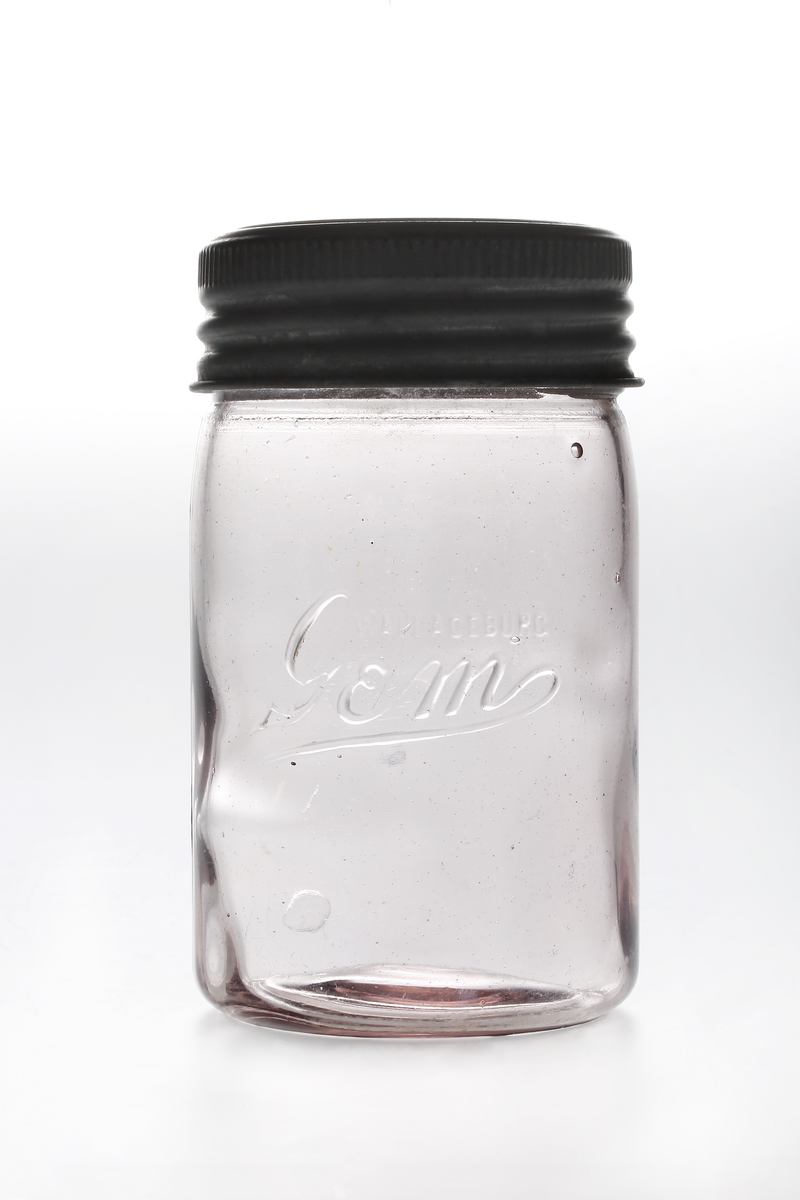
The McCord Stewart Museum holds one modest example of Wallaceburg’s output: a Gem-pattern preserving jar attributed to the Sydenham Glass Company and dated 1895–1913. Its catalogue records the town’s name embossed on the jar, along with Gem in script. At 14.5 centimetres high, it is an ordinary household vessel carrying the name of its manufacturing town. This particular jar belongs to the Montreal museum’s collection; it is not being presented as an object in Wallaceburg’s gallery. [2]
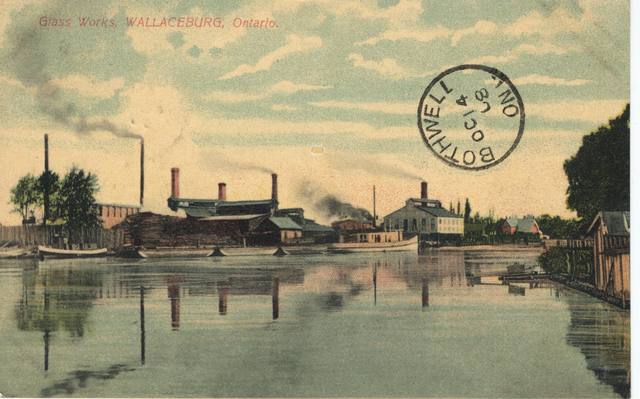
The factory needed a much larger network to make such small things. Chatham-Kent’s heritage account describes a site beside the Sydenham River and railway, with raw materials arriving by water and products travelling outward. The proposed use of local sand proved unsuitable; sand was brought from Michigan instead. The industry depended on connections beyond the town, even when its name appeared on the finished glass. [3]
A postcard in the University of Windsor’s archive, postmarked in 1908, preserves a view of the works. The postmark dates the card’s use, not necessarily the moment the photograph was taken. [4]
What workers made for themselves
Not everything preserved in Wallaceburg fits the idea of an interchangeable factory product. The museum’s Glass Gallery includes hand-blown pieces called whimseys, made by glassblowers in their spare time using leftover glass. Its examples range from birds and paperweights to walking sticks and glass chains. The gallery also includes a punch clock and retirement glasses: objects connected to working lives as well as commercial output. [5]
Here the wish for a second example meets a different problem. A handmade whimsey may have its own composition and design. Another piece can preserve evidence of the craft without being an exact replacement for the one beside it. The museum’s collection therefore carries two kinds of value: what a type of object demonstrates, and what belongs to an individual piece.
After the buildings
The plant closed in 1999. Chatham-Kent dates the demolition of its landmark Batch Tower to March 5, 2000. [3] Large structures disappeared, while smaller objects continued to reach collectors and museums.
Gregory’s 2024 comment is not a promise that glass can be made safe forever. It is a collecting response to a material that can break. In a town remembered for making glass, preservation sometimes means saying yes to one more.