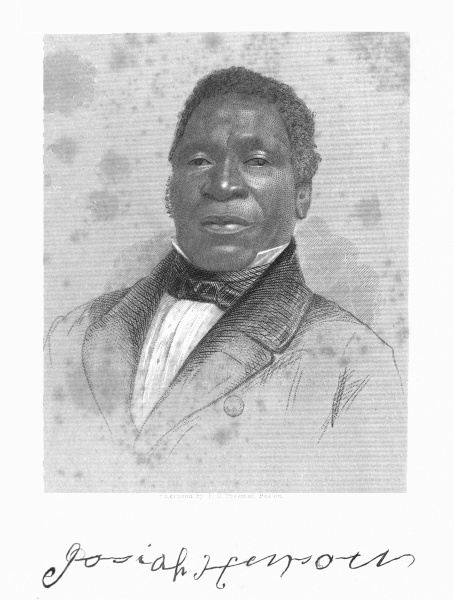
At London's Great Exhibition in 1851, Josiah Henson's walnut boards presented a problem that a finer polish could not solve: they were being displayed as American products.
At least, that is how Henson told the story in his 1858 autobiography. He had brought lumber from Dawn, the Black settlement near present-day Dresden, Ontario. When an American superintendent refused to let him move it to the Canadian section, Henson hired a painter. Large white lettering identified the work with a man who had escaped slavery in the United States and now lived at Dawn, Canada. In his account, the boards were moved the following day. [1]
Where is this place?
Dresden, Ontario, Canada. This map locates the town or region, not a verified exact historic event site.
The material was an export. The inscription insisted that it also had a history.
A school with a working day
Dawn was not simply a place from which Henson could send exhibits. It was a community trying to support people building lives after enslavement.
Henson helped establish the settlement in 1841. Its British American Institute connected education with practical work. The Ontario Heritage Trust records the school's opening in 1842 and describes days divided between lessons and a trade. Goods made by students helped support the school. Farming and enterprises including mills, brick-making and rope-making formed part of this economy. [2]
The boards belonged to that larger undertaking. In a 2007 account, Trust writers Wayne Kelly and Steven Cook located the timber on Institute lands and emphasized the students' work in producing the exhibition material. The polished surface represented a community's skills, not merely one traveller's possession. [3]
That distinction matters when a memorable encounter with a celebrated individual threatens to become the whole story.
Four boards, an Atlantic crossing
Henson described selecting four boards, each roughly seven feet long and four feet wide, from a shipment he had taken to Boston. They were packed there and travelled with American exhibition goods. He said he had them planed and polished after arrival in England. [1]
Their dimensions make the venture easier to picture. These were substantial specimens of timber, not small samples slipped into a coat pocket. Getting them to an exhibition required packing, transport and finishing before any visitor could admire the grain.
The shipping arrangement, in Henson's telling, produced the dispute over where the boards belonged. His painted identification changed what a viewer could learn from them. A polished board might advertise a marketable product; the added words connected production with freedom and a particular Canadian community.
The account is a recollection published seven years later, not a transcript of the exchange. Its force does not require treating the remembered dialogue as a recording. [1]
Recognition was not a balance sheet
The Trust's 2007 account reports a bronze medal for the exhibit. But an award in London should not be mistaken for a permanent solution to the Institute's finances. [3]
Parks Canada's history describes a settlement sustained partly by agriculture and industry, but still dependent on additional fundraising. It records continuing debt, criticism of the leadership and decline during the 1850s; the Institute closed in 1868. That longer history complicates a simple progression from escape to prosperity. Freedom also required resources, and recognition did not guarantee them. [4]
Nor was Canada free of racial discrimination. Parks Canada places the development of Black communities and their institutions within that continuing reality, rather than portraying the border crossing as the end of every struggle. [4]
Today, the Josiah Henson Museum of African-Canadian History in Dresden interprets this wider history through buildings, objects and accounts of Black life in Canada. Its present name also distinguishes Henson from the fictional character with whom his public reputation became entangled. [2]
The walnut boards offer another way to make that distinction. They bring Henson into view as an organizer and advocate, while directing attention back across the Atlantic to a school, a mill and the people whose work made an exhibit possible.