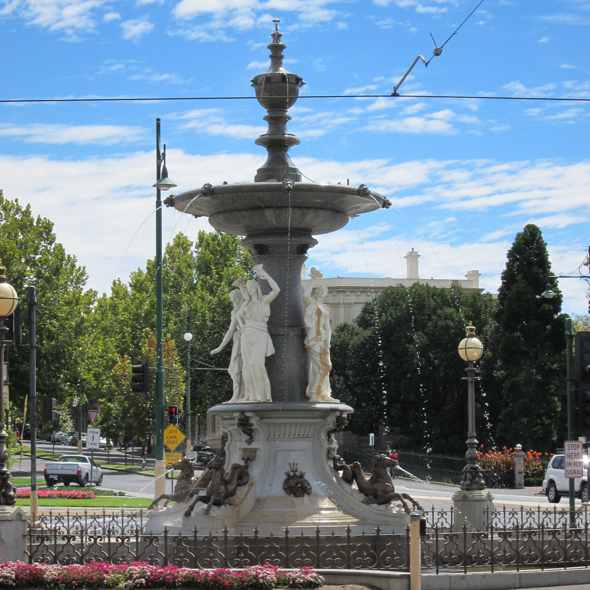
The pale figures around Alexandra Fountain do not look like an exhibition balance sheet. In Dansforth’s 2015 photograph, they stand beneath a dark bowl, surrounded by spouting creatures, flowers and traffic. The name and elaborate design suggest a civic monument. One of its funding sources points somewhere less permanent: a show held two years before the fountain opened.
The National Trust’s assessment records proceeds from the 1879 Bendigo Juvenile Industrial Exhibition alongside £500 from mining magnate George Lansell and £700 from Sandhurst City Council. Exhibition money was one contribution, not the entire cost. William Vahland designed the fountain, and local craftsmen constructed it. [1]
Where is this place?
Alexandra Fountain, Charing Cross, Bendigo — geographic context, not instructions to enter the road. This map locates the town or region, not a verified exact historic event site.
What the show rewarded
Two catalogued awards make that exhibition less abstract. Bendigo Historical Society catalogues a first-class certificate awarded to Maggie Sneddon of Sandhurst for a model bed. Dated 30 June 1879, the certificate carries an image of the Corn Exchange building and a border of Australian flowers. This description comes from the collection’s record; it does not establish Sneddon’s age or explain how the model was made. [2]
The City of Greater Bendigo’s Civic Collection holds another award: a silver medal bearing George R. Bennett’s name, South Yarra, and an inlaid-marble chess table. The object’s inscription preserves a particular entrant, place and entry rather than merely announcing that an exhibition occurred. [3]
There is a useful caution in the city’s accompanying history. It describes the Sandhurst exhibition as broader than the juvenile-artisan event held in Ballarat the previous year. Natural and manufactured products from the surrounding district received more space. The word “juvenile” in the fountain’s funding history should not turn the whole event into a children-only competition. [3]
A model bed and a chess table were not components of the fountain. They are evidence of the range of work represented at the event that helped finance it.
A different kind of display
The fountain offered a much larger stage. It was named for Alexandra, Princess of Wales; her sons Albert and George attended its opening on 5 July 1881. Harcourt granite, cast iron and painted stone formed a composition of figures, marine creatures and water at Charing Cross. [1]
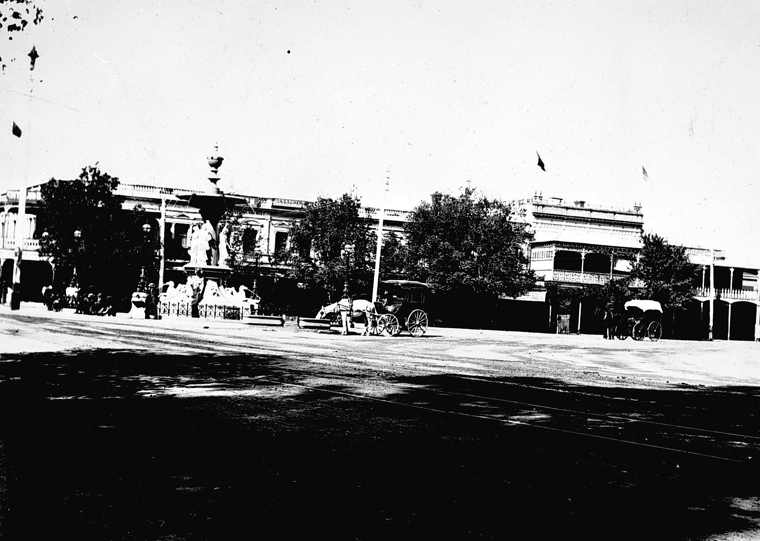
Thomas George Beckett’s photograph, dated 12 April 1898 by Museums Victoria, places the fountain within a street of shops, trees and horse-drawn vehicles. It is not a picture of the exhibition or the opening ceremony. It shows the monument becoming part of the everyday setting beyond those occasions. [4]
The photograph and the awards preserve different scales of public recognition. A certificate or medal names an entrant and an achievement. The fountain combines contributions into something encountered at a crossroads, where its exhibition connection is not immediately apparent from its shapes.
Bendigo did not just award prizes and pack away a show. Some of the exhibition’s proceeds became another display—one too large to fit inside a winner’s cabinet.