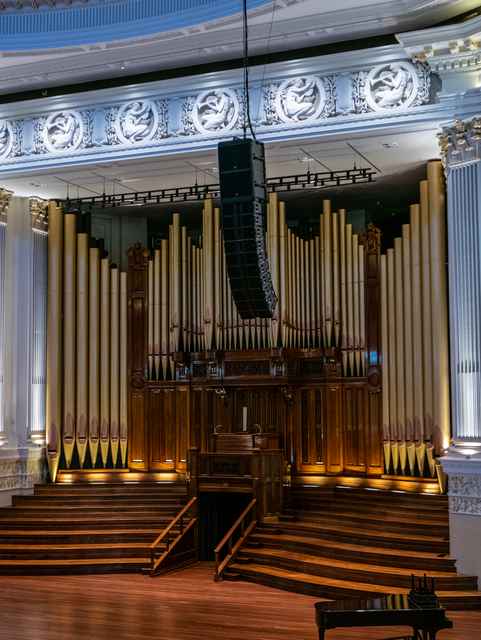
Before Brisbane City Hall’s organ case could be French polished, its old polyurethane coating had to come off. Barnes Construction & Joinery, subcontracted by Pierce Pipe Organs, removed that coating mechanically rather than with solvents. The firm’s project account describes preserving the wood beneath it, then polishing and helping reinstall the casework. [1]
The instrument had already changed homes. Henry Willis and Sons built it in London in 1891–92 for Brisbane’s Exhibition Building at Bowen Park. The council bought it in January 1900, but it stayed there until 1927, when it was removed for rebuilding, enlargement and installation in the new City Hall. [1]
Where is this place?
Brisbane City Hall, Queensland. This map locates the town or region, not a verified exact historic event site.
The 2010–14 restoration did not return every part to a single earlier year. Geoffrey Cox’s technical history for the Organ Historical Trust of Australia records a plan centred on the 1929 specification, while retaining some additions made in 1991. Other 1991 changes were reversed. The project also supplied a new blowing plant in a specially built room high inside the organ. [2]
The front pipes received their own treatment: their grey paint was removed and replaced with a gilt finish. The console’s mismatched thumb pistons were replaced with ones matching the Willis III design. These were separate jobs from the French polishing of the wooden case. [2]
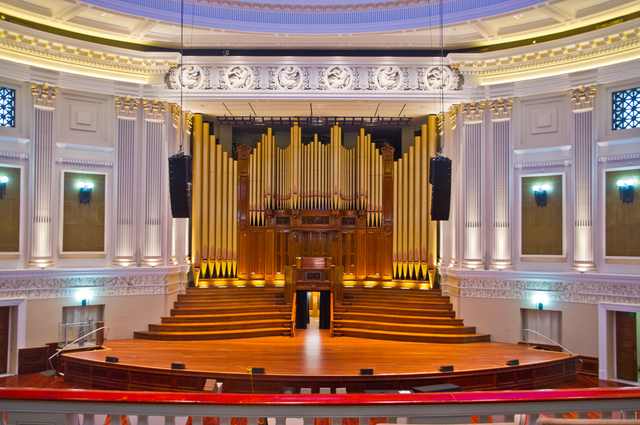
The hall reopened in April 2013; the organ’s reopening followed on 10 August 2014. Organist Christopher Wrench’s concert archive lists Thomas Heywood and Andrej Kouznetsov for that day, then David Bailey accompanying silent films in the evening—including Buster Keaton films and a restored version of The Phantom of the Opera. [3]