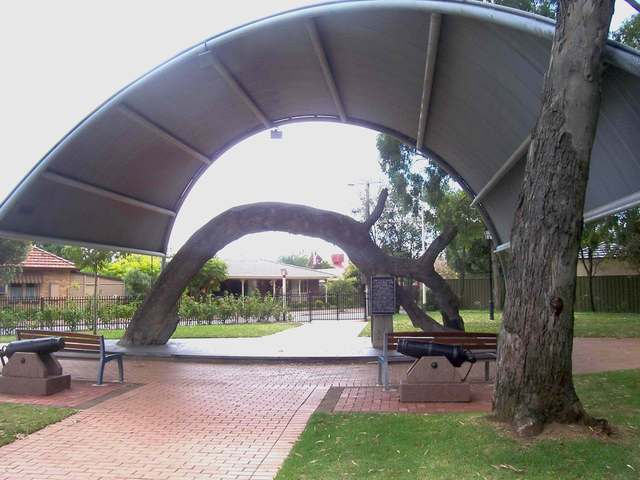
Plastic and cement became part of Glenelg’s Old Gum Tree in 1963. The treatment is recorded in Hignett & Company’s 1983 heritage survey: the river red gum had gradually deteriorated before it was remodelled. The survey does not quantify how much wood remained. [1]
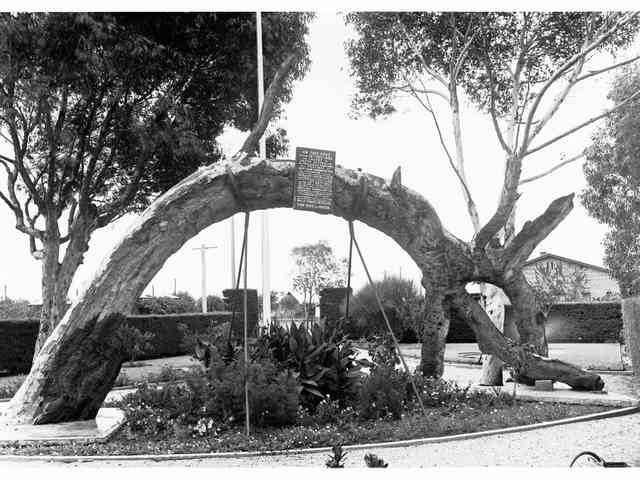
An earlier photograph, catalogued by the History Trust of South Australia as 26 February 1936, shows the arch with braces beneath it and bands across its upper surface. A commemorative plaque hangs near the middle. In the later colour photograph, the arch stands beneath a broad canopy, with a plaque mounted beside it. The two views record different arrangements, not an untouched tree. [4–5]
Where is this place?
Old Gum Tree, Glenelg North, South Australia. This map locates the town or region, not a verified exact historic event site.
The wording around the tree had also been debated. According to the 1983 survey, a Royal Geographical Society subcommittee proposed a new plaque in 1935, ahead of South Australia’s centenary. It would have described colonial children playing around the tree and placed the proclamation of 28 December 1836 nearby—not necessarily underneath it. The proposed tablet was not erected. [1]
That distinction remains in the state heritage database, which describes the location as a “Supposed site” of the proclamation establishing government. The protected place is listed as the Old Gum Tree Site, at 43 MacFarlane Street, Glenelg North. [2]
Colonial commemoration was not the beginning of the tree’s significance. The state environment department’s account of historian Susan Marsden’s 2025 talk notes its earlier importance to Kaurna people. It also describes how Charles Hill placed the arched tree at the centre of his large proclamation painting, a work that took twenty years to produce. [3]
The commemorative ground grew too. John Hector gave Glenelg a 64-foot-square plot in 1857. A council purchase of adjoining land in 1957 extended the site to 64 by 112 feet. [1]