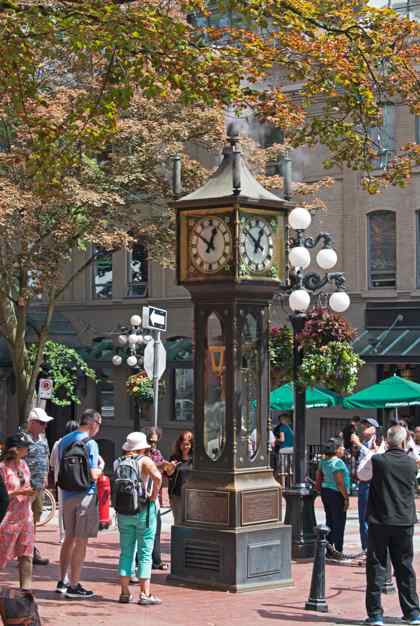
In a 2007 interview, Ray Saunders described a selective coating inside Vancouver’s Gastown Steam Clock. He lacquered the movement’s parts to prevent rust, leaving the gear teeth uncoated. [1]
Saunders distinguished steam from damp air. Steam did not contact the timekeeping movement, he told the National Board Bulletin; cool, moist air circulating inside the clock could leave condensation on it. The movement had a pendulum and gears driving the hands. [1]
Where is this place?
Gastown Steam Clock, Vancouver. This map locates the town or region, not a verified exact historic event site.
The same account described the winding apparatus as a small steam engine driving a chain with ring-shaped buckets. These lifted one-pound steel balls to an upper track, where they transferred to another chain. The descending weights drove the clock movement. Winding, keeping time and sounding the whistles were different jobs. [1]
Vancouver’s engineers had already put some of the less conspicuous work into writing. Their February 1999 report listed a heated, filtered air intake at the clock’s base among improvements scheduled over the preceding years. Replacing the winding transmission and preparing a maintenance manual were also on that list. The report was not a completion record for each item. [2]
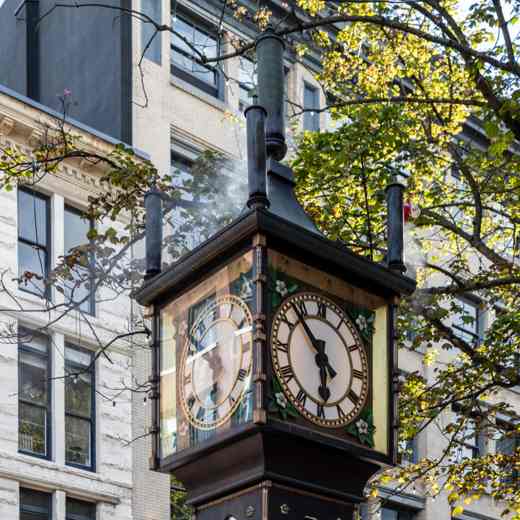
Its routine-maintenance allowance covered the exterior as well: cleaning once a month in winter and every two weeks in summer. Inside, it separately named the movement, winding devices and tune-playing machine. [2]