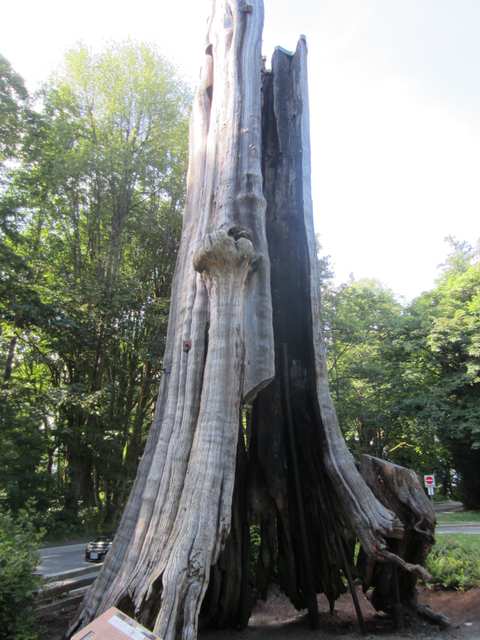
At Vancouver’s Hollow Tree, a narrowing opening did not necessarily mean the trunk was crumpling. In its October 2008 conservation plan, the Stanley Park Hollow Tree Conservation Society compared early-twentieth-century photographs with recent views, scaled to match. The group concluded that the stump’s overall shape had stayed comparatively stable while its front dropped about a metre. The apparent shrinkage was largely a result of tilt. [1]
The team tested movement as well as appearance. A carefully controlled hydraulic jack raised one temporary support timber by three inches while investigators measured the force and watched how the tree moved. Their imaging indicated that it rotated as a unit. The report treated this as evidence that straightening might be feasible, not a guarantee that the full operation would succeed. [1]
Where is this place?
Hollow Tree, Stanley Park, Vancouver. This map locates the town or region, not a verified exact historic event site.
Arborist Julian Dunster inspected the stump’s base. A separate laboratory strength test used wood from another ancient red cedar stump, not from the landmark. Checks at attachment points were still planned. [1]
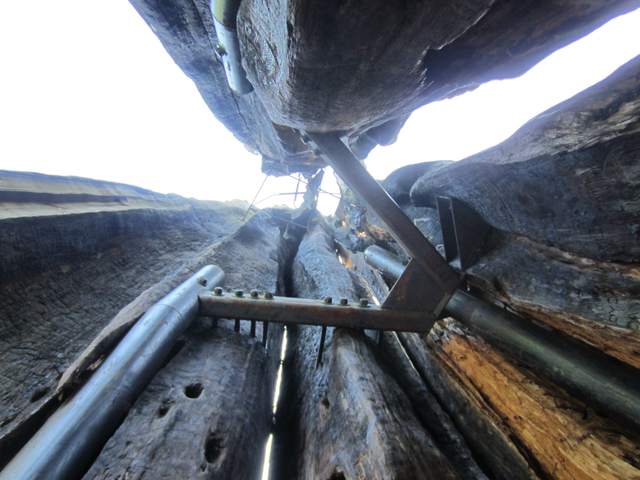
By January 2009, Park Board staff and the City Engineering Department had reviewed Cascade Engineering Group’s drawings. The Board approved the design to realign and stabilize the Hollow Tree on 19 January. The City’s later account records a public ceremony for the restored stump in October 2011. [2][3][4]