The crane was only part of the move. Before a canoe could leave the Canadian Canoe Museum’s old Peterborough home, someone had to make a support that fitted it. That support would have another job after the truck arrived. [1]
In Megan Gallant’s May 2023 interview for kawarthaNOW, curator Jeremy Ward described a preparation process measured in individual objects, not truckloads. Staff and volunteers examined, cleaned, photographed and documented the watercraft. Each received a custom cradle suited to its shape. Those cradles were intended to remain useful in the new museum’s collection storage, rather than becoming disposable packing. [1]
Where is this place?
Peterborough, Ontario — community orientation, not the route used to move the collection. This map locates the town or region, not a verified exact historic event site.
Work that would travel with the collection
The reported cradle-building time was 45 minutes to an hour apiece. Preparing a vessel took about two hours on average when cleaning was included. These were the team’s working estimates, not a formula for handling any historic boat. [1]
Some of the people undertaking the move had volunteered for more than two decades. Ward recalled helpers who had also supported the collection’s earlier arrival in Peterborough. Gallant’s article records their continuity alongside the new building’s promise. The publication disclosed that it was the move campaign’s official media sponsor; its interview is a participant account, not an independent audit. [1]
A support that travelled with its object connected those two kinds of work: the temporary disruption of moving and the continuing responsibility of looking after a collection.
A canoe long enough to change the load
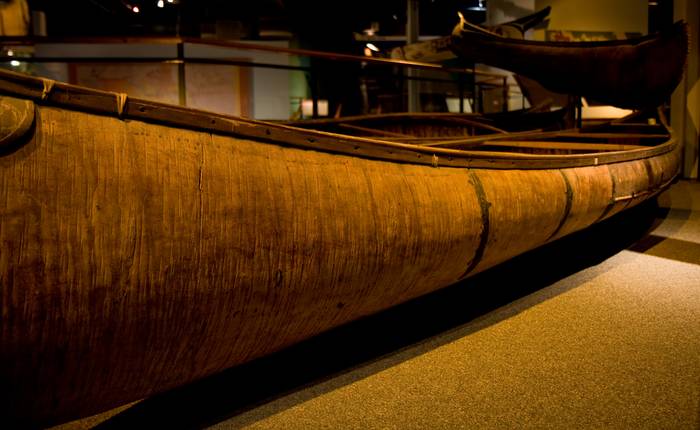
The moving company’s account gives the scale a name: Blue Bird. McWilliams Moving & Storage identifies the racing canoe as 53 feet long and shows its crew working with museum staff to secure it. The firm was both official mover and lead sponsor, and its account is written from that role. [2]
This was not the company’s first journey with the collection. McWilliams also records moving the original collection from Dorset to Peterborough in the 1990s. The later relocation included watercraft, paddles, archives and a library—not simply the largest objects in the exhibition. [2]
The museum’s 2023 annual report describes Blue Bird travelling on a specially supplied flatbed and being craned into the new second-floor Exhibition Hall. It rounds the canoe’s length to 16 metres. The two descriptions should be read as differently rounded measurements, not evidence of two boats. [3]
The move had stages, not one finish line
The annual report records 115 canoes lifted into the Exhibition Hall over nine days. Its year-end tally is broader but still incomplete: more than 250 canoes moved by December 31, and more than 500 custom cradles built. The collection numbered over 600 watercraft. Those figures do not mean that the entire relocation was finished in 2023. [3]
The R. Howard Webster Foundation, a supporter of the project, records the new museum opening in May 2024. Its description distinguishes an Exhibition Hall with over 100 watercraft from a Collection Hall storing more than 500 others. Storage was part of the new museum, not simply somewhere offstage to put what did not fit. [4]
The difference gives the cradles a modest but important place in the story. The large canoe and the crane made an extraordinary sight. The fitted supports answered a less spectacular question: what would keep doing useful work once the extraordinary journey was over?