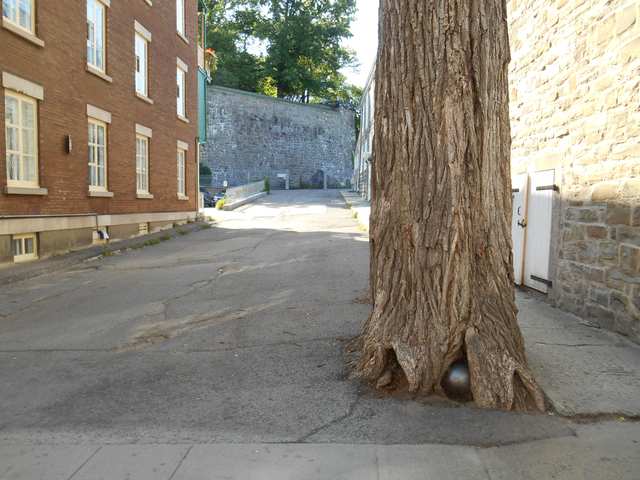
The crew removing Québec’s “cannonball tree” had more than branches to deal with. In its account of the operation, the Comité des citoyens du Vieux-Québec describes workers clearing concrete and asphalt from the elm’s base, then military bomb-disposal specialists extracting the metal ball. Part of the trunk went to the Fonderie d’Art d’Inverness. The tree was felled in 2021; the ball was kept. [1][2]
The object had supplied a story almost ready-made for a guidebook: a British cannonball fired in 1759, supposedly lifted from the earth by the growing tree. Québec’s municipal art record rejects that explanation. It identifies an old incendiary bomb repurposed as a chasse-roue—a guard protecting buildings from the wheels of horse-drawn vehicles. The elm grew around it at the corner of rue Saint-Louis and rue du Corps-de-Garde. [2]
Where is this place?
Former elm site, rue Saint-Louis and rue du Corps-de-Garde, Québec City. This map locates the town or region, not a verified exact historic event site.
There had been an attempt to work out how to keep the tree. Forest engineers Luc Nadeau and Roxanne Maheu examined it on 27 August 2020. Their firm’s report found extensive decay in the trunk and would not recommend leaving it without intervention. A proposed support structure offered a possible alternative to felling, but the authors stressed that its feasibility still required investigation and approval. It was a preliminary scheme, not a completed rescue system. [3]
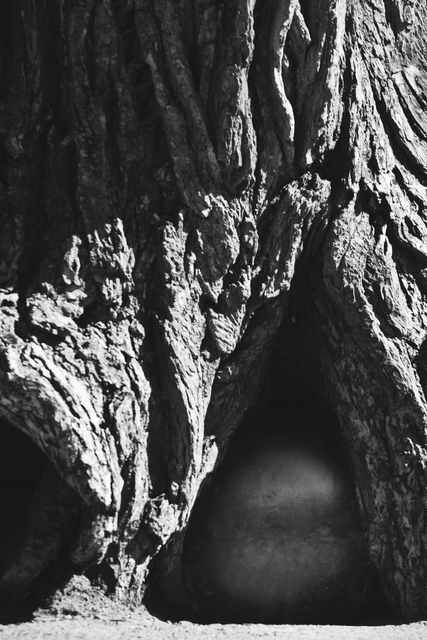
Paryse Martin’s 2024 sculpture, Porter les songes à la limite du ciel, brought the surviving material into another form. Residents contributed to the work’s conception; it incorporates fragments of the elm and the recovered projectile, with the tree’s base reproduced in bronze. The city’s art listing describes a temporary display elsewhere while street works delay its return to the original corner. A heart-shaped knot in the bark is among the details carried into the sculpture. [2]