The doors at Point Clark were closed, but the light was still doing its job. A March 2014 report described the Lake Huron lighthouse as closed to visitors for years, yet still serving maritime traffic during restoration. A building could be unavailable to the people who wanted to climb it without becoming useless to the people offshore. [1]
That distinction is the most interesting part of a project easily mistaken for a fresh coat of whitewash. The tower had two audiences, and repairing it meant bringing one audience back without forgetting the other.
Where is this place?
Point Clark, Ontario, Canada. This map locates the town or region, not a verified exact historic event site.
First, find out what the wall contains
The Township of Huron-Kinloss dates the closure to 2010, when stone was spalling—breaking away from the tower. The initial plan involved removing the whitewash, replacing damaged stone and renewing mortar joints. As work advanced in 2011, the damage proved worse than expected. [2]
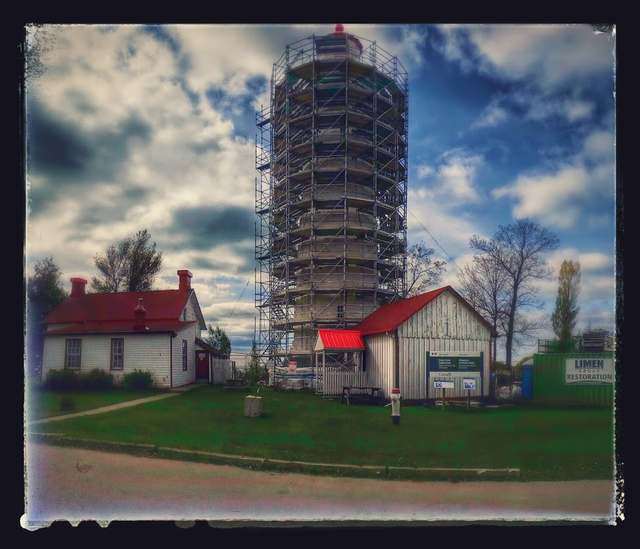
In 2012, the investigation became extraordinarily specific: every stone and mortar joint was assessed and mapped. That is a revealing way to look at a landmark. From the beach, it reads as one white tower. For the people trying to conserve it, it had become an inventory of individual pieces and their condition. [2]
The township records more than 400 replacement stones in a tower containing over 1,400. Preserving the outline did not mean leaving every part untouched. Nor did it mean replacing the whole thing. The difficult work lay between those two choices. [2]
A local material, a complicated job
In March 2014, the Daily Commercial News spoke with Arran Brannigan, vice-president of operations at restoration contractor Limen. His account gives the work a scale that a distant photograph cannot supply. The crew had to consolidate the rubble core inside the masonry, provide temporary structural support and arrange scaffolding around a round building. [1]
Replacement stone also required a decision. After tests established the properties of the existing stone, the contractor sourced compatible Eramosa limestone from Wiarton; original material was conserved where possible. The repair connected this lakeside tower to another Bruce Peninsula place through a material chosen for a particular job, not simply for looking suitably old. [1]
This is where the familiar idea of “restoration” becomes less comfortable and more useful. A clean exterior is the result people can see. The choice of stone, the hidden core and the support needed during the work belong to the process that made that result possible.
Opening the door again
The federal government's June 27, 2015 announcement marked the reopening after a $3.7-million conservation project. It described work on exterior stone, masonry and windows, and identified the separate responsibilities behind the site: Parks Canada owned the lighthouse, the Canadian Coast Guard operated it for navigation, and the township welcomed visitors and ran the museum in the former keeper's house. [3][1]
Those are not interchangeable jobs. One concerns the survival of the building, another its continuing use on the water, and another the public encounter with it on land. The reopening joined them again in a way a closed door had temporarily concealed.
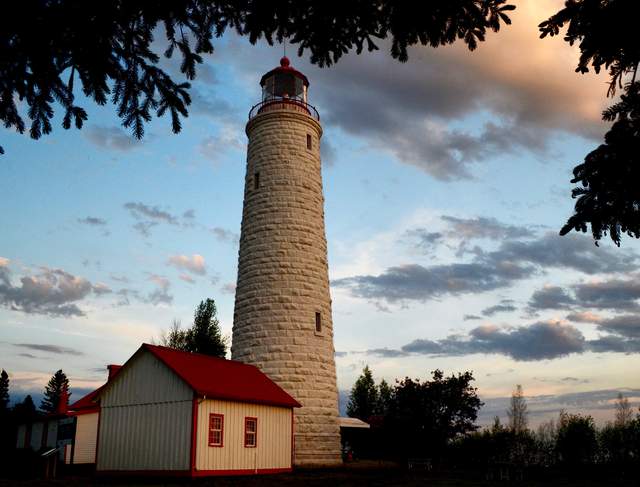
The tower itself was built between 1855 and 1859. Its age helps explain why it attracts attention, but the restoration offers a less obvious reason to stop here: old infrastructure can remain working infrastructure. In 2015, visitors were returning to a structure whose other audience had not simply disappeared during the closure. [3][1]
The best detail to carry away is not a height or a superlative. It is that stone-by-stone map. A recognizable place survived through attention to the differences inside what, from a distance, looked like one thing.
This account concerns the 2010–2015 restoration. It is not a statement of current visiting hours; check the township's visitor information before planning a visit.