The key changed hands before the lighthouse could reopen. On July 31, 2026, Bayham mayor Ed Ketchabaw presented a symbolic key to Ken Kokko, president of the Port Burwell Historical Society. The society describes the ceremony as the beginning of its stewardship of the 1840 tower. It was not announcing that visitors could climb it again. [1]
That distinction matters in a town where the lighthouse has already survived one major community rebuilding. Taking responsibility for an old structure and making it usable are different kinds of work.
Where is this place?
Port Burwell, Ontario, Canada. This map locates the town or region, not a verified exact historic event site.
Keeping a light, not a monument
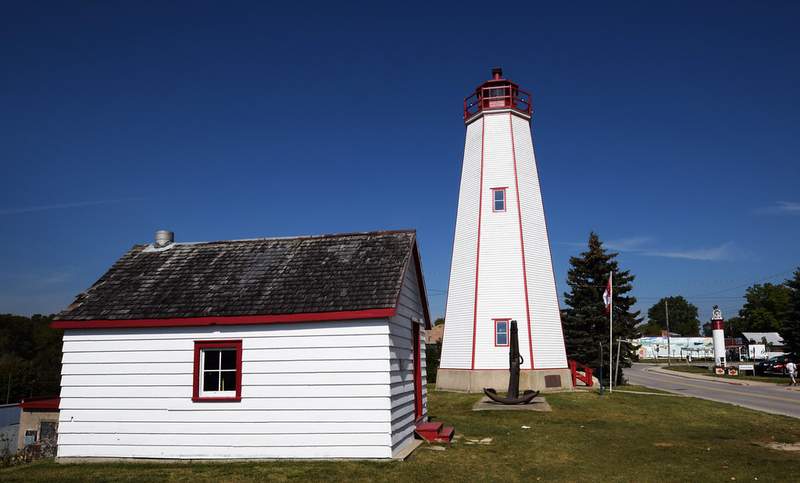
The tower began as working equipment above Lake Erie. An interpretive plaque connects its light to the shipping of local timber and explains the advantage of its hilltop position: the lantern stood considerably higher above the water than the tower's own height. [2]
An 1876 federal inspection entry puts Alexander Sutherland's workplace into sharper focus. It lists three lamps, three fifteen-inch reflectors mounted on an iron frame, and a wooden lantern with zinc covering its floor. The inspector praised its condition. [3]
Those particulars make the lighthouse less abstract. A light depended on fittings, surfaces and someone attending to them. The surviving tower recalls that labour as well as the ships it served; it was never simply a shape on the skyline.
The repair that became part of its history
The Village of Port Burwell acquired the tower in 1965. Two decades later, local Mennonite craftsmen undertook a substantial restoration. The historical society's account, drawn from Frank and Nancy Prothero's local history, identifies Leroy Eicher and his sons working with hand tools in 1986. Decay proved more extensive than expected, and long structural timbers and siding were replaced. [1]
The National Trust for Canada's account likewise credits that community restoration with keeping the tower in public use for decades. The work is now part of what the community is preserving: an old building that reached the present through replacement and skilled intervention, not an untouched object carried forward from 1840. [4]
What the new key represented
Bayham's June 2026 public notice records a different sort of preparation. Council had declared the property surplus and directed the municipality to pursue a transaction with the historical society. The notice invited written public comments before a special meeting on July 30. [5]
The society reports that council authorized the transfer at that meeting; the National Trust also records the change of ownership. The July 31 key ceremony followed. [1,4] A municipal property had become a responsibility carried by a community organization.
The next steps were not a ceremonial relighting. The society's restoration milestones record a structural investigation beginning September 1, intended to inform a work plan. An assessment is a step toward deciding what must be done, not evidence that repairs are finished. [6]
As checked on October 27, 2026, Bayham's own visitor page still said the lighthouse was closed because of structural concerns, with stabilization measures in place. [7] No reopening date is promised here.
Port Burwell's story therefore has no neat final rescue scene. The 1986 craftsmen made one future possible. The 2026 transfer assigned the task of making another. The small, visible action of handing over a key marked a much larger obligation: to turn public affection for the tower into the practical work of keeping it standing.