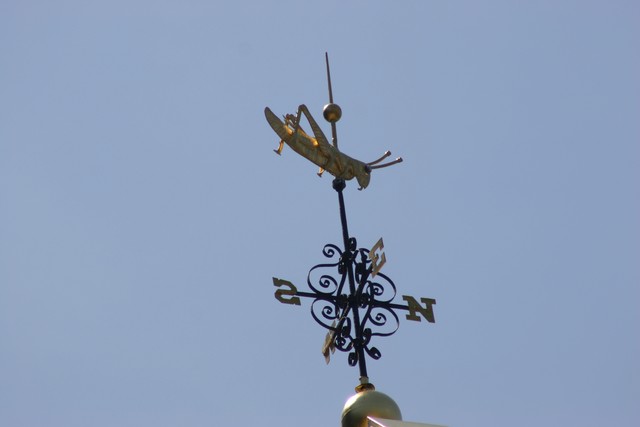
Thomas Drowne put a message inside Faneuil Hall’s copper grasshopper, addressed “To my bretheren and fellow grasshoppers.” Dated 28 June 1768, the note spoke as the insect: it recalled a fall, fire damage and the repairs that had put it back to work. Boston’s Landmarks Commission reproduces the text in its study of the hall. [1]
Thomas’s father, Shem Drowne, had made the gilded weathervane in 1742. The National Park Service gives its length as four feet and one inch and identifies its material as sheet copper. Its model was the grasshopper above London’s Royal Exchange. [2]
Where is this place?
Faneuil Hall, Boston, Massachusetts. This map locates the town or region, not a verified exact historic event site.
Shem also left a less playful record of maintenance. Boston Public Library’s inventory of town papers lists his bill of 28 April 1756 for repairing the Faneuil Hall grasshopper. The catalogue records the amount as £9.13.4. [3]
The commission’s report connects Thomas’s later repairs with the fire that damaged Faneuil Hall in 1761. His note describes the grasshopper as injured and then mended by its maker’s son. [1]
Other coppersmiths worked on the vane afterward. NPS records restorations by E. B. Badger and Sons in 1889 and 1899, and describes several time capsules inside the body. The cupola beneath it changed too: Badger replaced the wooden structure with a copper-and-steel replica in 1899. [2]
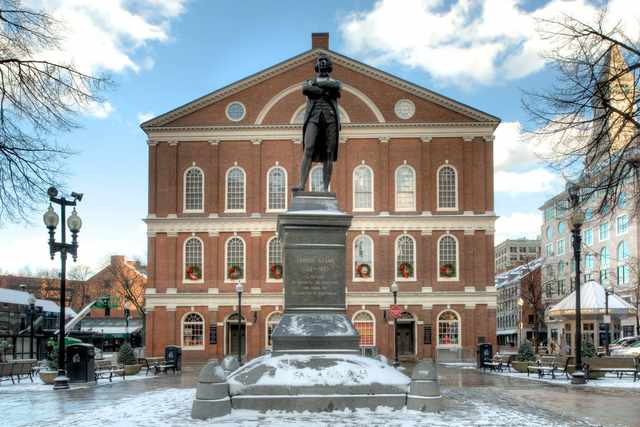
Thomas’s earlier message ended with a promise to do its job, qualified by a weathervane’s unavoidable condition: “yet I shall vary as ye wind.” [1]