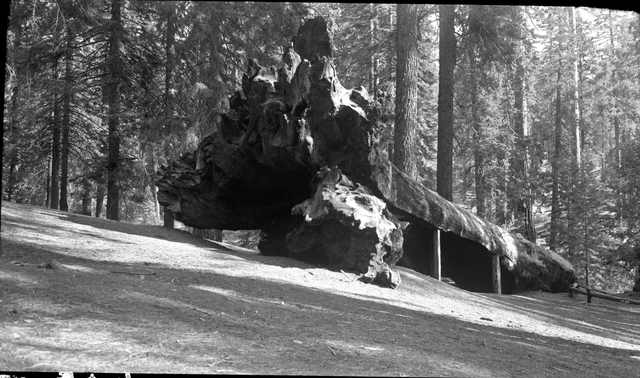
The cavalry horses at Grant Grove had an unusual stable: a fallen giant sequoia. Fire had hollowed the trunk of the Fallen Monarch, leaving a space that people had already used as a home. Howard R. Stagner’s The Giants of Sequoia and Kings Canyon, in its 1958 printing, records both the Gamlin brothers’ temporary lodging and the later military stable. [1]
Israel and Thomas Gamlin also served food and drink from the log, according to National Park Service historian A. Berle Clemensen’s 1975 account. Israel’s timber cabin, built in 1872, stood nearby. The hollow tree and the assembled cabin would both become useful to the soldiers sent to administer General Grant National Park after its creation in 1890. [2][3]
Where is this place?
Fallen Monarch and Gamlin Cabin, Grant Grove. This map locates the town or region, not a verified exact historic event site.
The cabin held the horses’ feed. In 1892, troops dismantled it and moved it, log by log, to a site roughly two-thirds of a mile southeast. Later, civilian ranger L. L. Davis cleaned out the former grain store and made it his residence. These changes are recorded in the cabin’s National Register nomination. [3]
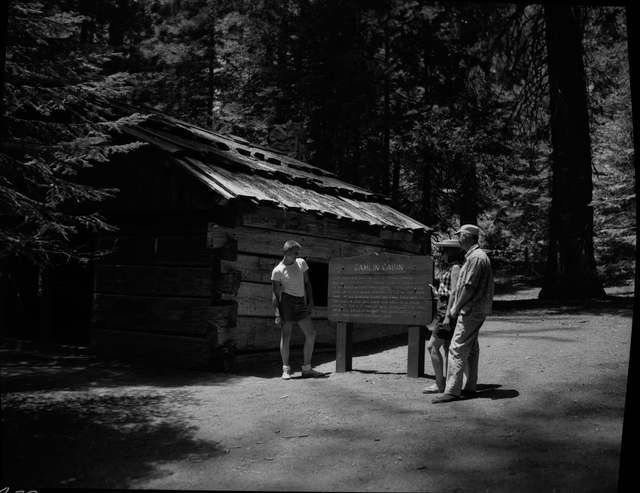
The cabin made a second journey after a tree crushed part of its roof in the winter of 1931–32. Neighbors objected to plans to dismantle the damaged building. Superintendent John R. White agreed to return it to its original site; volunteers helped with the move in 1932 and returned the following year to repair the roof and fireplace. The National Park Service’s trail description now places the cabin and the walk-through Fallen Monarch on the same loop. [3][4]