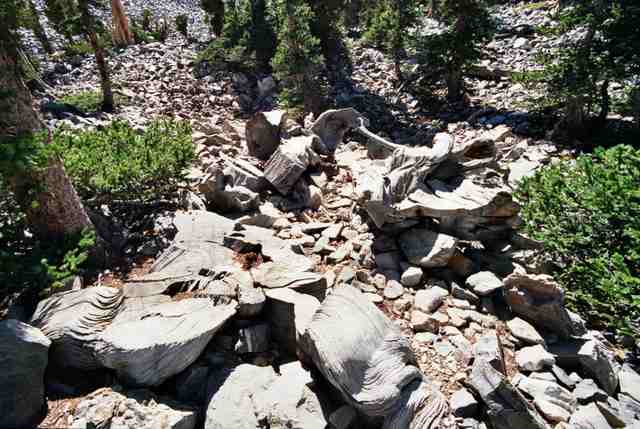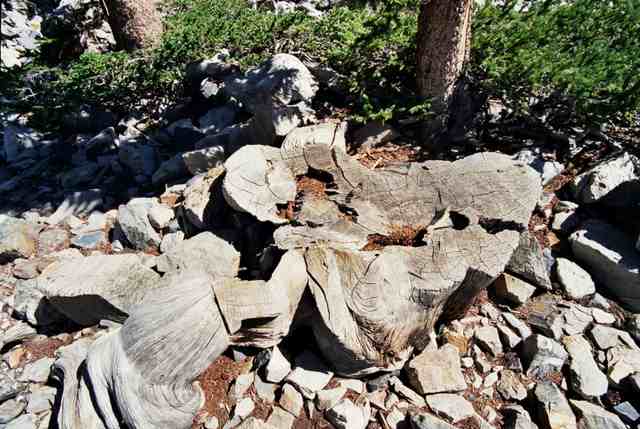
An early age estimate for Prometheus came from counting rings. After the bristlecone pine was cut down in Nevada in 1964, one count yielded 4,844; a later count by D. Graybill raised that to 4,862. But those figures were not the result of crossdating, Matthew Salzer and Chris Baisan explained in a 2013 conference abstract. [1]
Crossdating compares patterns of broad and narrow rings across wood samples. Matching those sequences lets researchers assign calendar years to rings, rather than treating a tally as a complete chronology. The University of Arizona’s Laboratory of Tree-Ring Research explains the method using overlapping samples from living trees, dead trees and old building timbers. [2]
Where is this place?
Great Basin Visitor Center, Baker, Nevada — park orientation, not the stump location. This map locates the town or region, not a verified exact historic event site.
For Prometheus, the laboratory obtained the portion containing the tree’s centre. Salzer and Baisan reported crossdating its inner section against high-elevation tree-ring records from California and Nevada. They dated an inner ring to 2936 BC and concluded that the tree had lived for more than 4,900 years. The work was reported almost half a century after the cutting. [1]
Donald Currey, then a graduate student, had been studying glacial features near Wheeler Peak when the tree was felled. The National Park Service’s account confirms that he had Forest Service permission to cut it, but does not settle the conflicting stories about why coring gave way to cutting. The stump remains in what is now Great Basin National Park; a section of wood, acquired by the Arizona laboratory decades later, supplied the crossdating result. [3][1]