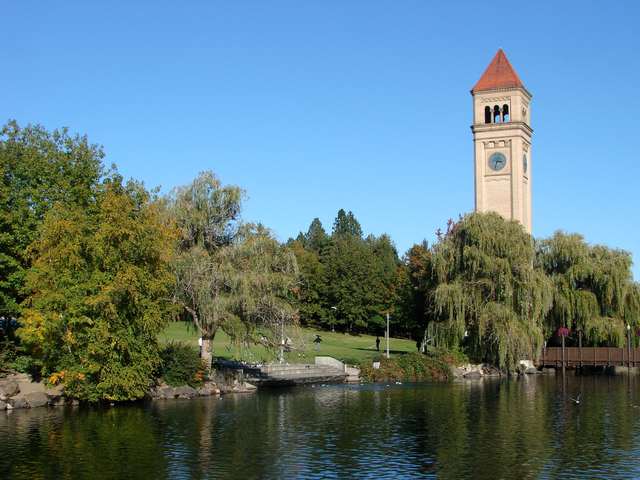
In Adam Jones’s 2009 photograph, Spokane’s red-roofed clock tower rises beyond a river and trees. The faces offer a readable account of time. They reveal much less about how the landmark acquired a musical voice—or how differently its hands and chimes have been maintained.
The tower belonged to the Great Northern Railway depot, completed in 1902. The depot disappeared during preparations for Expo ’74; the tower remained. That outcome was contested, not automatic. A city account published in 2021 credits Jerry Quinn Sr.’s Save Our Stations campaign with rallying support through advertising. It helped preserve a landmark, not the entire station around it. [1][2]
Where is this place?
Great Northern Clock Tower, Riverfront Park, Spokane, Washington, United States — exterior landmark context, not tower-entry directions. This map locates the town or region, not a verified exact historic event site.
Ninety-nine turns, then six songs
The missing building left a clue on the surviving tower. Riverfront Spokane’s description points out sloping traces of the former roof on the east and west walls. Part of what now looks like a freestanding structure once stood inside another building. [3]
The same operator account describes a decidedly physical clock routine: a technician climbing five stories each week and turning a crank 99 times. A pendulum weighs about 200 pounds; counterweights descend roughly 40 feet between windings. Four clock faces connect to the mechanism through shafts. These details describe the work behind the hands, not the production of music. [3]
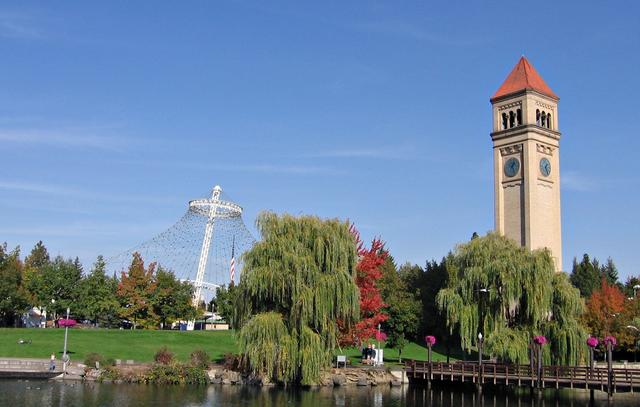
The tower originally had no bells or chimes, according to the city’s July 2026 history. Ahead of Expo ’74, Betty Castle and supporting organizations and businesses arranged a carillon memorializing her late husband, George. Mylar rolls directed the music like those of a player piano: six songs apiece, including local college fight songs. [4]
An electronic replacement followed in 1998, with installation funded by the Spokane Parks Foundation. On 1 July 2026, the city reported another installed after more than a decade’s silence, using remaining Expo +50 funds through the Innovia Foundation. Remnants of the original carillon stayed inside. The release announced a forthcoming July Fourth rededication; it records an installation, not a reporter hearing the ceremony. [4]
A clock face, a winding crank and a roll of songs belong to different parts of this story. Saving the tower did not freeze them together in 1902. Its railway outline survived, while the sound associated with it was added, replaced and preserved in fragments.