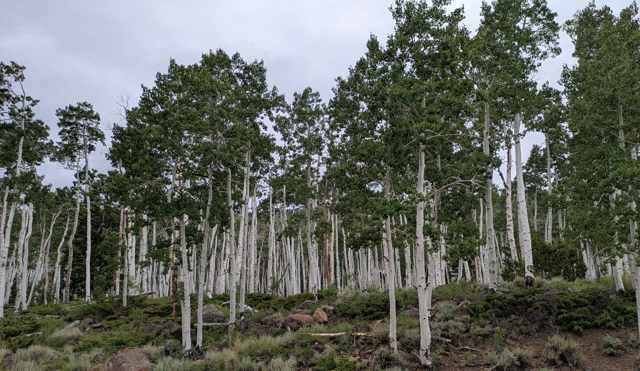
At Pando, counting animal droppings was only half the job. Researchers then removed them from their transects, so the next visit would count new deposits—not the same evidence twice. Fresh scat inside the fence could reveal that animals were getting through. [1]
This aspen clone in Utah’s Fishlake National Forest covers about 43 hectares. Its many trunks are genetically identical stems, rather than a collection of unrelated trees. [2]
Where is this place?
Pando, Fishlake National Forest, Utah. This map locates the town or region, not a verified exact historic event site.
For their 2014–2016 study, Paul C. Rogers and Jody A. Gale used 27 plots. Each had two perpendicular measuring strips, 30 metres long and two metres wide. They counted young aspen by height and recorded missing terminal buds where animals had browsed them. [1]
Fencing-only plots finished with an average of 1,359 young stems per hectare, against 105 in untreated plots outside. These were stems no taller than two metres—not a count of replacement canopy trees already grown. [1]
Nor did one successful enclosure settle the whole grove’s future. The researchers’ 2021 university brief described a different, larger fence erected in 2014 that deer had breached. Visitors had reported deer inside, browsing signs were present, and new growth was minimal. [2]