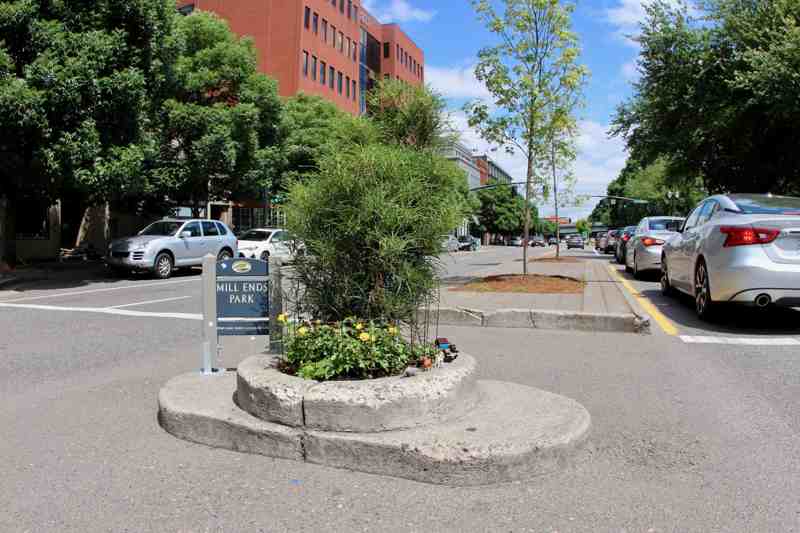
In a photograph taken in June 2018, Mill Ends Park has a municipal sign, yellow flowers and a tiny bench. Cars pass on both sides. The planting sits inside a circular concrete rim; the sign announces its name with the seriousness of a much larger park.
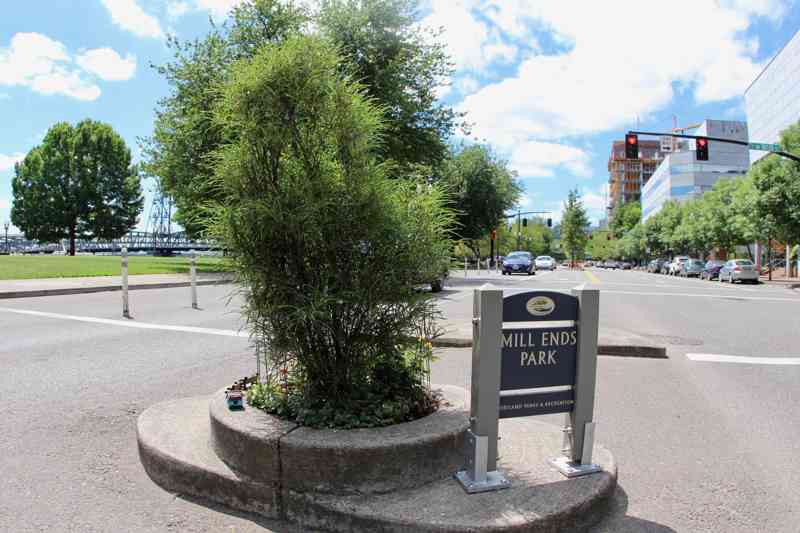
A second photograph, taken from the other side, makes the contrast sharper. Beyond the little planting are traffic signals, a broad street and the trees of Portland’s waterfront. The park is not a model of a city. It occupies a small, real piece of one.
Where is this place?
Mill Ends Park area, SW Naito Parkway and Taylor Street, Portland — geographic context, not street-crossing directions. This map locates the town or region, not a verified exact historic event site.
What happens when a road project reaches a place like this? Portland’s answer involved removing the entire park—and putting it back six inches to the west. [1]
A small place in a larger project
In its January 2022 announcement, Portland Parks & Recreation described Mill Ends’ return during the substantial completion of Better Naito Forever. The rebuilt park received a cloverleaf-shaped border and a new sign. City crews made the sign from recycled materials, reproducing the design of their ordinary park signs at miniature scale. [1]
The photographs here show the older, circular version, not that rebuild. They are a useful reminder that even this apparently enduring curiosity has had different physical forms.
The surrounding project operated at another scale. Landscape architecture firm Mayer/Reed, a participant in the work, describes a temporary, volunteer-led experiment begun in 2015 becoming permanent infrastructure. Its team worked with David Evans & Associates engineers and city bureaus on the waterfront corridor. The completed connections, including a related project to the south, extended dedicated walking and rolling space along 22 blocks. [2]
Mayer/Reed’s account records an official opening on May 6, 2022. That was later than the city’s January announcement about the little park’s return. A project can have several milestones; a ribbon-cutting is not necessarily the day every individual piece first reappears. [1][2]
The joke acquired responsibilities
The city’s park history traces Mill Ends to journalist Dick Fagan, who planted flowers in a vacant light-pole hole outside his newspaper office. His column supplied stories about its imaginary leprechaun inhabitants. An informal dedication in 1948 preceded recognition as an official city park on St. Patrick’s Day in 1976. [3]
The distinction between invention and administration is part of the pleasure. The leprechauns belong to Fagan’s storytelling. The maintenance does not. In the 2022 announcement, the parks bureau placed Mill Ends under its downtown maintenance team, with watering and weeding to be done. [1]
That is a different measure of a park from its acreage: someone has to remember it when there is work to assign.
A record can move farther than a park
Mill Ends is often introduced through its former world record. That introduction now needs a date. Guinness World Records announced in February 2025 that a park in Nagaizumi, Japan, measuring 0.24 square metres held the smallest-park title. Its account explicitly identified Portland as the previous holder. It also reported that the Japanese park’s creation had been inspired by a visit to Mill Ends. [4]
The superlative changed hands; the Portland story did not disappear with it. Its interest lies in the collision of scales: a newspaper fantasy became a named municipal place, a major street project made room for its return, and a sign-maker treated a few letters as seriously as those at a larger entrance.
Six inches was a short move. Remembering to put the whole park back was the larger gesture.