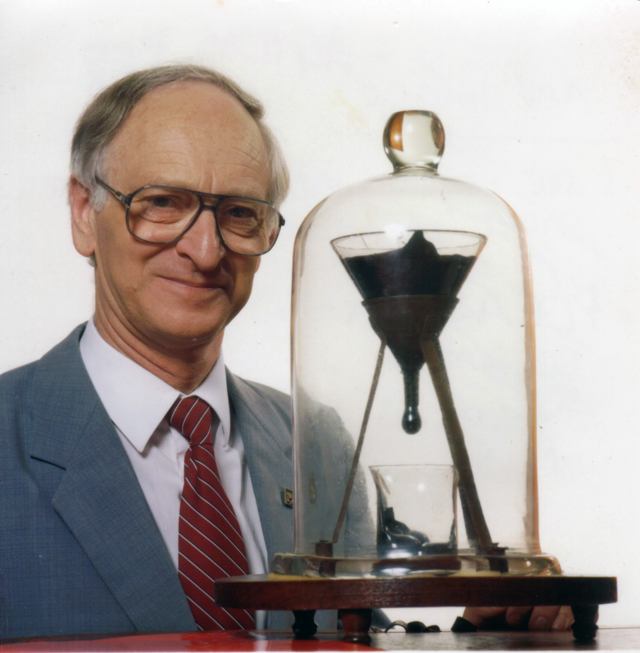
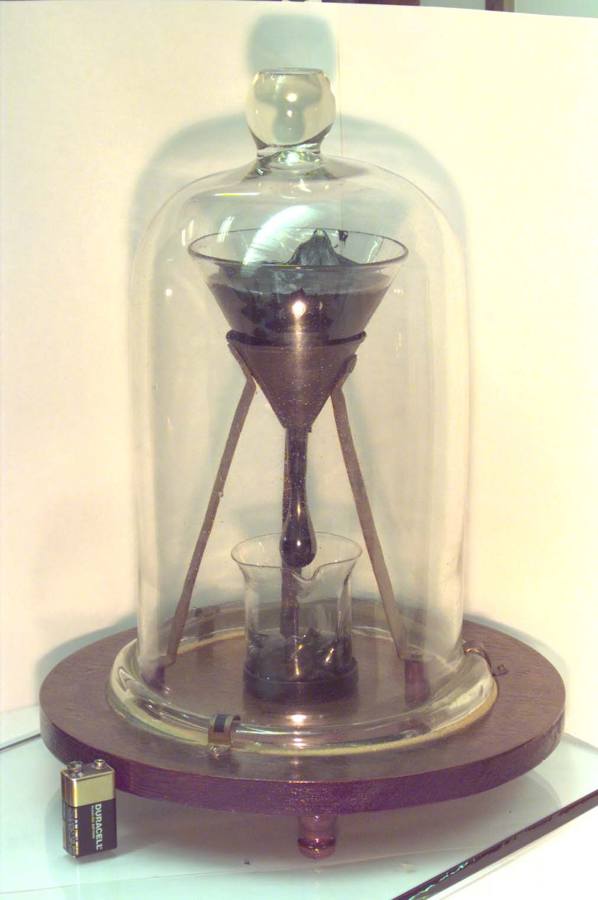
At the University of Queensland in April 2014, a drop of pitch had reached the pile in its receiving beaker without detaching from the funnel above. It had taken more than thirteen years. Custodian Andrew White wanted to exchange the crowded beaker before the ninth drop joined the older ones permanently. He and former custodian John Mainstone had discussed making room for future drops.[1][2]
On 24 April, removing the glass cover caused the separation instead. A deteriorated seal between the bell jar and its wooden base briefly pulled the apparatus upward with the cover. When it fell back, the pitch stem snapped at the funnel. The broken stem had a depression in its centre: the drop had been supported by an outer ring, not a solid circular cross-section.[3]
Where is this place?
Parnell Building, University of Queensland, St Lucia. This map locates the town or region, not a verified exact historic event site.
The apparatus had another complication that year. Its display lights stayed on for viewers watching online, and the halogens heated the enclosure. On 17 October, White and camera operator Andrew Stephenson measured pitch near the funnel’s top at almost 10°C warmer than the hanging drop. Cooler LEDs replaced the halogens. Stephenson reported that the apparatus returned to room temperature, but past temperature records did not exist; he could not quantify how much the earlier heating had changed the flow.[3]