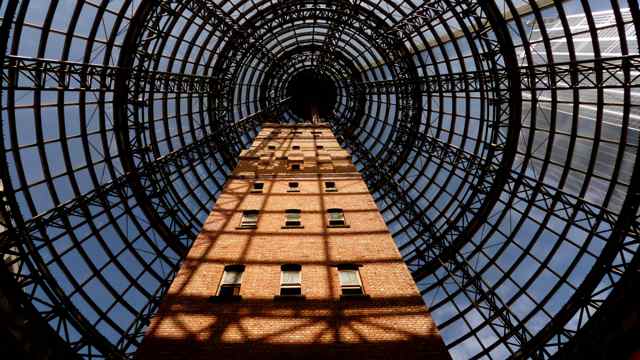
Look upward in Bernard Spragg’s September 2015 photograph and the old brick tower seems to climb into a second, much larger building. Glass and steel surround it. The contrast is so complete that it can make Melbourne Central look like a simple story: an industrial landmark saved inside a shopping centre.
That story is true as far as it goes. But the tower survived a transformation that did not keep its whole neighbourhood.
Where is this place?
Coop’s Shot Tower, Melbourne Central — geographic context, not a route through the centre or current access guide. This map locates the town or region, not a verified exact historic event site.
Coop’s Shot Tower and its adjoining building were part of central Melbourne’s late nineteenth-century manufacturing landscape. The tower was used to make lead shot; it was not a decorative imitation of a factory. Andrew May’s eMelbourne account records its eventual incorporation beneath the shopping complex’s glass cone. [1]
The centre’s own heritage account credits architect Kisho Kurokawa with enclosing the retained tower within that cone. Melbourne Central opened in 1991. The old structure became an unusually prominent feature of the new development, rather than disappearing behind a shopfront. [2]
The building and the district were different things
Before that transformation, the surrounding lanes supported a mixture of trades. Melbourne Central’s history describes ironmongers, tailors, furniture makers and other businesses working in the block bounded by Swanston, Elizabeth, Lonsdale and La Trobe streets. The Coops belonged to this busy manufacturing setting; they were not operating an isolated monument. [2]
A National Trust of Australia (Victoria) retrospective, published in 2016, places the development in a more complicated conservation story. It records the retention of the shot tower inside the new shopping complex, alongside the loss of the block’s industrial laneway buildings. [3]
The two accounts illuminate different scales of preservation. One concentrates attention on a conspicuous survivor. The other asks what happened around it. Saving the tower did not preserve the surrounding workshops and their relationships as a complete district.
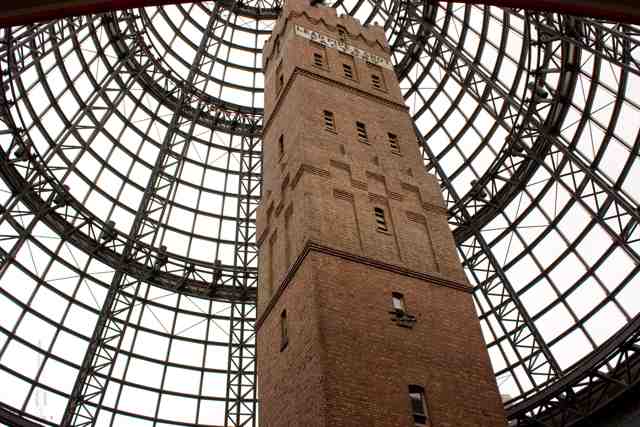
This does not mean that every older alley vanished. The centre’s heritage account identifies Knox Place as a surviving service and delivery alley associated with the tower’s former address. A remnant street and a retained building, however, are not the same thing as an intact working neighbourhood. [2]
Laneways became a design problem again
When ARM Architecture later redesigned Melbourne Central, circulation was central to its work. In the architects’ account, the earlier centre interrupted pedestrian routes and was difficult to navigate. Their response was to introduce a network of laneways and additional entrances, linking movement through the retail complex more closely with the surrounding streets and railway station. [4]
ARM dates its first completed stage to 2005 and a second to 2012. This is the designer’s account of its project and intentions, not an independent measurement of every commuter’s experience. Nor were the new retail passages a reconstruction of the old industrial businesses. [4]
The photographs here show the surviving tower and its enclosure, not the vanished district or a map of those later routes. Rexness’s closer view makes the industrial wording high on the brickwork easier to notice; Spragg’s view emphasises the scale of the glass structure around it.
Melbourne Central holds both a saved object and evidence of a changed city. The tower remains recognisable. What it means to pass it—on the way to a workshop, a shop or a train—belongs to the history of everything around it.