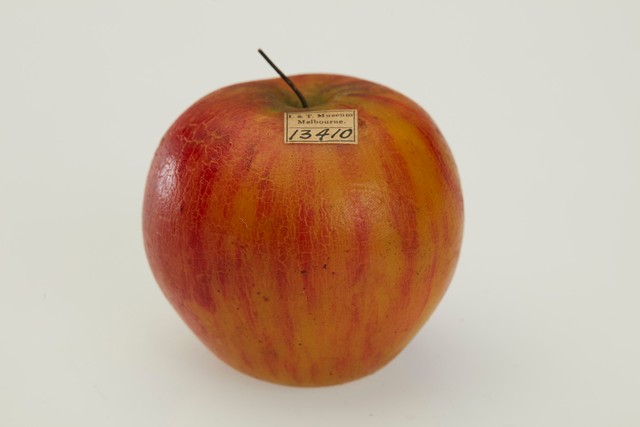
A red-and-yellow apple in Museums Victoria’s collection has a wire sticking out where its stem should be. It is not an eccentric variety. The catalogue explains that the wax covering the stem has gone. This is a model of a Shockley apple, and part of what the photograph records is now the model’s own history. [1]
That distinction matters in a collection built to preserve imperfections. Museums Victoria describes more than 1,800 wax fruit and vegetable models, most made by museum artisans between 1873 and 1960. Their makers did not simply tidy produce into attractive shapes. They copied bruises, mould and variations in colour, recording healthy, diseased and unusual specimens. [2]
Where is this place?
Burnley Gardens, Melbourne, Victoria, Australia — historical growing-site context for the 1884 specimens, not a present display location. This map locates the town or region, not a verified exact historic event site.
A Burnley apple, not just an apple
The Shockley record supplies a particular origin: a specimen grown at the Horticultural Society of Victoria’s gardens at Burnley and presented in 1884. The model was made in the museum, but its maker was not recorded. The fruit has a named growing place and a year; the person who reproduced it remains unnamed in this entry. [1]
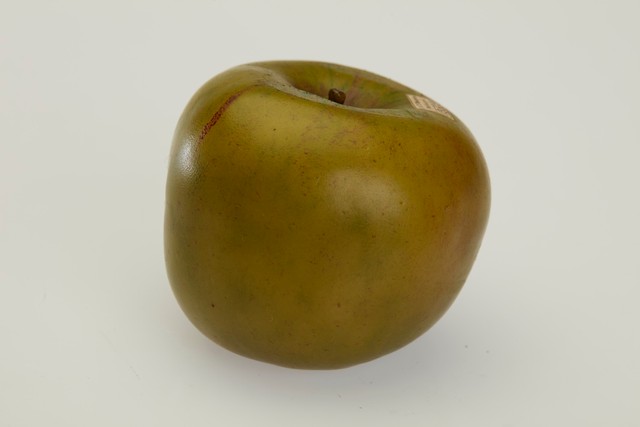
Another 1884 Burnley specimen became the Winter Majetin model. Its catalogue describes green colouring, a pronounced dimple and a brown scar beside it. Jon Augier’s photographs show these two surviving museum objects, not freshly picked fruit. The missing wax on the Shockley’s stem is an especially useful warning: a model can preserve evidence of an apple while also acquiring damage of its own. [1][3]
A comparison that could outlast a harvest
The objects also belonged to a practical system of comparison. In their 2015 study of scientific teaching models, Jan Brazier and Molly Duggins describe the Victorian museum’s wax-fruit collection by 1878 as a reference against which claims of novelty or exceptional quality could be checked. Citing a report in The Australasian that year, they show how an imitation could help assess a claim about real produce. [4]
Museums Victoria describes a two-copy arrangement with the Department of Agriculture, which sourced specimens: one model went to the department, the other to the museum. It also identifies the trained modellers as mainly women. Wax produce appeared in the Victorian Ladies Court at Melbourne’s 1880 International Exhibition—four years before the two Burnley specimens pictured here. Those photographs should not be mistaken for evidence of that earlier display. [2]
Read together, the records make a more demanding object than a decorative imitation. A variety name, growing site, date and copied surface could turn a perishable specimen into something people could compare later. But precision was unevenly distributed: Burnley and 1884 survive in both entries, while neither names the modeller. Here, the fruit is easier to identify than the hands that copied it. [1][3][4]