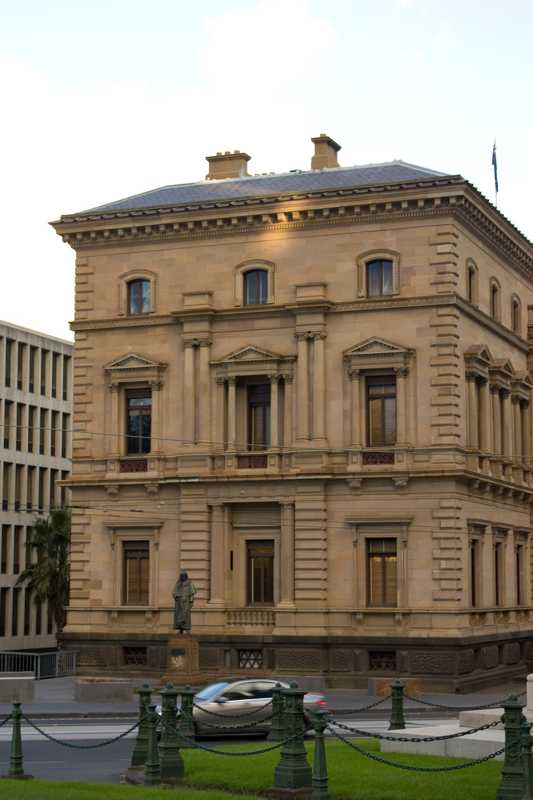
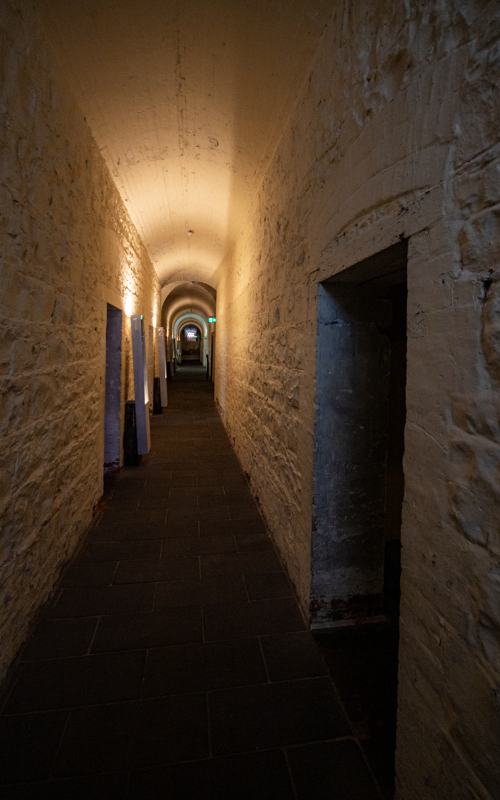
A fruit barrow is an unexpected detail in the history of Melbourne’s Old Treasury Building. The museum’s account of the Maynard family places one in a basement passage near the lift-well. Mr Maynard bought cases of fruit at Victoria Market and brought them back to sell. The building’s superintendent had something besides keys and cleaning to attend to. [1]
The setting makes that small trade memorable. Designed by John James Clark, the Treasury adopted the grand forms of an Italian Renaissance palace. Its sandstone exterior enclosed brick walls and bluestone foundations. Construction began with the basement and lower levels in 1858; the building was completed in 1862, though other work followed. [2] The museum’s gold-rush exhibition describes the original arrangement as sturdy vaults below and impressive government offices above. It also acknowledges uncertainty about how much gold was actually stored there. [3]
Where is this place?
Old Treasury Building, 20 Spring Street, East Melbourne — building context, not the barrow’s mapped position or a current access promise. This map locates the town or region, not a verified exact historic event site.
A home that was also somebody else’s workplace
By the 1920s, the Maynards were living downstairs: two parents and eight children in five rooms. Mr Maynard supervised security, maintenance and the cleaning staff. Mrs Maynard’s responsibilities crossed the boundary between household and institution too. Alongside caring for the family, she prepared morning and afternoon tea for the Governor’s regular meetings. [4]
That detail changes the familiar upstairs-downstairs picture. Family life did not simply occupy spare space beneath official business. The work of maintaining the building—and helping its meetings run—entered the household’s day. The museum presents the family’s residence as part of the Treasury’s working life, not an unrelated domestic episode. [4]
Its account of daily chores describes children carrying hot water, washing dishes and replenishing the wood stove’s water supply. These were repeated tasks, not just picturesque furnishings in a period kitchen. The fruit barrow belonged to this account of ordinary work too. [1]
The dining room offered warmth from a fire. Mrs Maynard used a treadle sewing machine there to make and mend clothes, with a view towards the courtyard, stables and washhouse. The museum also records evening visits from friends who played piano and sang. A caretaker’s home could contain duties, company and music without any of those cancelling the others. [5]
A re-created home, not a sealed room
There is an important distinction between that remembered household and its museum presentation. The Old Treasury’s 2014–15 annual report describes Growing up in the Old Treasury as a re-creation of the family’s residence. In the same account, basement vaults held displays about the gold rush. [6] The domestic exhibition was an interpretation of a former home, not a claim that every object had remained untouched since the Maynards lived there.
The photographs here offer another, narrower kind of evidence: Rexness’s exterior view from 2010 and Steven Penton’s vaulted passageway from 2025. Neither records the family or its fruit sales. The passage cannot be identified from that photograph as the precise place where the barrow stood.
The barrow matters because it interrupts the monumental view. A treasury can be remembered through impressive rooms and the valuables it was built to hold. The Maynard story adds the work of the people who kept a home inside it. Near the lift, the museum’s account leaves room for another transaction: fruit bought at market and offered for sale.