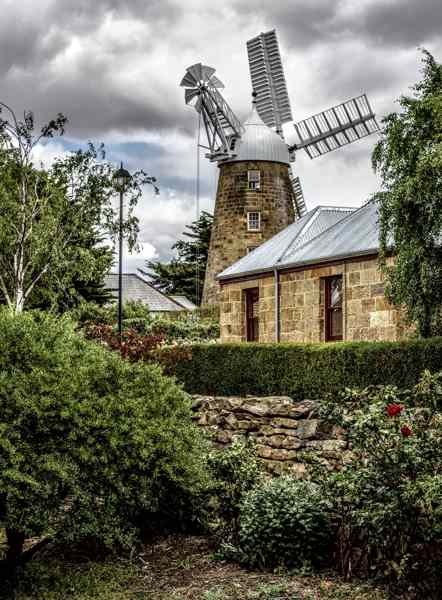
When steam milling arrived at Callington Mill in Oatlands, it took over a building meant for grain. By 1846, the granary housed a steam-powered mill, with a boiler and tall brick chimney behind it. Grain was subsequently stored upstairs in the stables, according to the site history assembled by Southern Midlands Council archaeologist Brad Williams. [1]
The stone windmill had opened in 1837. Its founder’s son, John Vincent junior, continued operating it while adding steam power. In October 1846 he advertised grinding at sixpence a bushel, or ninepence with dressing included, and promised customers prompt completion of their orders. Jill Cassidy and Keith Preston’s history of Tasmanian flour milling traces the business under the names Oatlands Wind and Steam Mill and Oatlands Flour Mill. [2]
Where is this place?
Callington Mill, Oatlands, Tasmania. This map locates the town or region, not a verified exact historic event site.
Later owners kept changing the equipment. John Bradshaw advertised a new silk dressing machine in 1870 and a Boddington patent millstone in 1873. A sale offering in 1876 listed elevators, a twelve-horsepower engine, a circular saw and a weighbridge. By an 1888 sale notice, the windmill was being described as storage space, while the steam mill was still trading. The familiar tower and its neighbour had exchanged the roles of production and storage. [2]
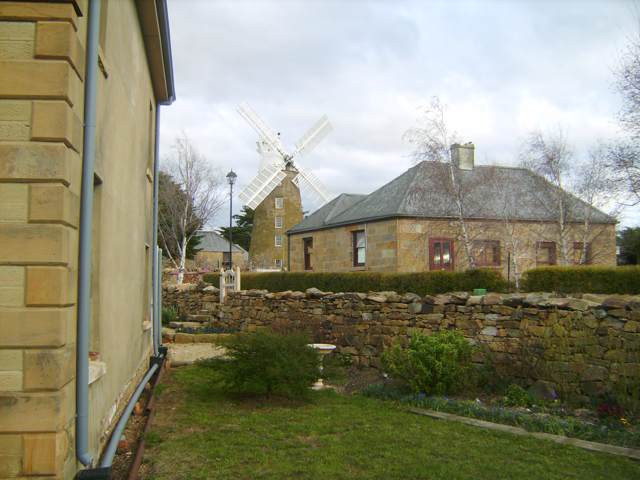
A second mill to investigate
After the windmill’s 2010 reconstruction, Williams prepared a research design for the former steam-mill buildings behind the granary. There was a practical reason to dig: high ground levels were contributing to damp in the surviving building, and lowering them could disturb archaeological remains. His proposal joined drainage work to investigation of the former mill’s layout. [1]
The research questions included whether traces of machinery could show a functional connection between the wind and steam operations. An earlier resident’s recollection that old equipment was thrown into a well gave them another question to investigate. These were questions for excavation, not discoveries announced by the plan. The proposal allowed for remains to be covered again if leaving them exposed would cause damage. [1]