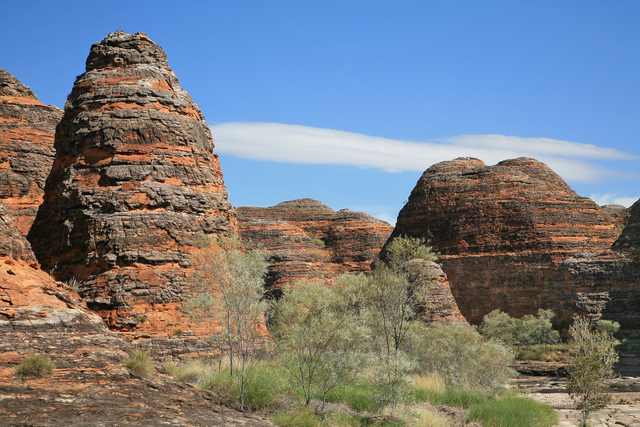
The dark stripes around the Bungle Bungle domes can be several metres wide. Their living coating is only a few millimetres thick. Australia’s heritage department identifies cyanobacteria—microscopic organisms on the sandstone surface—as the source of those dark bands in Purnululu National Park, Western Australia. The width visible across a dome is not the depth of a solid dark rock layer.[1]
Why do the organisms grow in stripes? A Western Australian parks booklet traces the pattern back to differences within the sedimentary layers. Sandstone containing more clay holds moisture, providing conditions that favour cyanobacteria. Layers with less clay are more porous and dry faster; there, the organisms have less suitable conditions. Oxidised iron gives the exposed surface its orange colour.[2]
Where is this place?
Purnululu National Park, Western Australia. This map locates the town or region, not a verified exact historic event site.
The ancient river deposits therefore supplied more than the material from which the domes were eroded. They also left alternating surfaces that retain water differently. In the booklet’s account, the dark coating occupies just the outermost millimetres of sandstone, while the physical differences between its layers extend beneath it.[2]
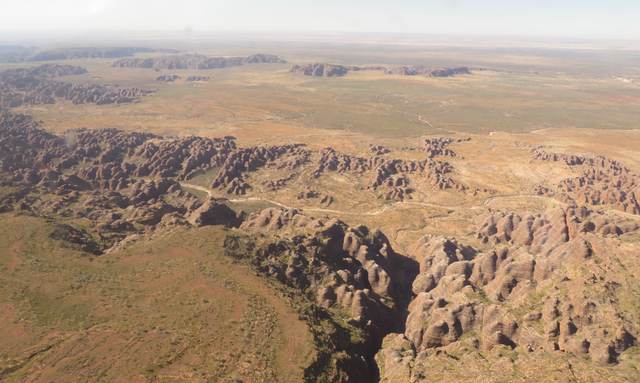
That thin coating does a second job. The heritage department says the crusts help stabilise and protect the fragile towers. The stripe is both a visible trace of organisms growing there and part of the surface resisting erosion.[1]