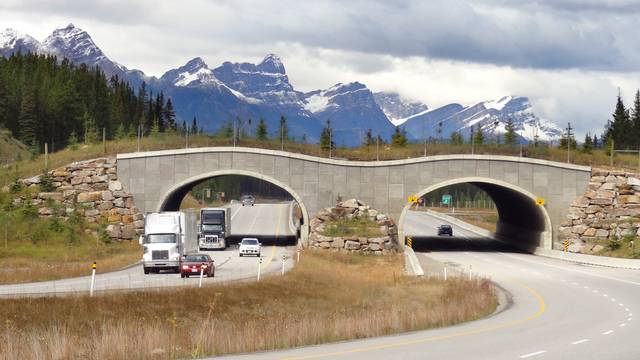
At twenty wildlife crossings in Banff’s Bow Valley, researchers collected bear hair rather than just counting passing animals. Michael Sawaya and colleagues compared DNA from those crossings with samples gathered elsewhere in the valley during 2006–2008. They wanted to know whether bears crossing the highway were also breeding. [1]
The Trans-Canada Highway’s widening had brought fencing to keep animals away from vehicles, along with passages beneath and above the road. Monitoring showed that different species favoured different shapes: grizzlies tended towards high, wide crossings, while black bears preferred narrower, lower underpasses. Some animals took years to adopt the new routes. [2]
Where is this place?
Banff National Park, Alberta — regional context. This map locates the town or region, not a verified exact historic event site.
The genetic study, published in 2014, identified seventeen black bears and fifteen grizzlies using crossings. Parentage analysis found evidence of reproduction in eight of those black bears and four of the grizzlies. [1]
One male black bear was assigned eleven offspring with five females; offspring were detected on both sides of the highway. This was evidence of family connections that a sequence of crossing photographs could not supply on its own. [1]
The grizzlies still showed a genetic divide associated with the road. The authors found exchange across it, not the disappearance of every barrier. They also cautioned that a connection between frequent crossing and breeding success did not establish that crossing more often caused greater success. [1]
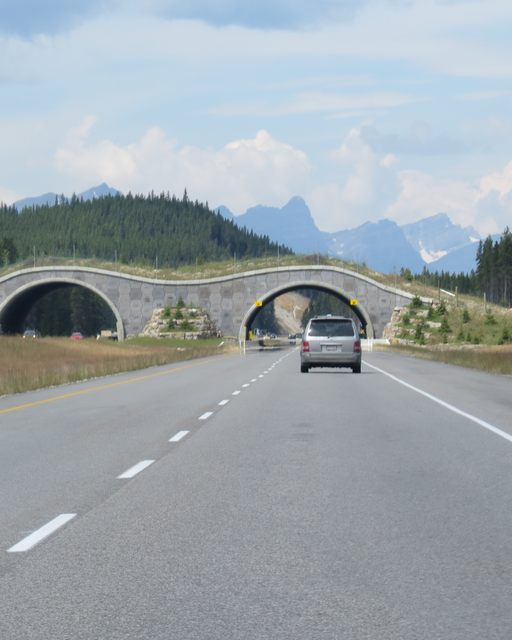
Parks Canada’s monitoring guidance gives the overpasses a practical boundary: people are prohibited from using them. When humans use crossings, animals tend to use them less. [2]