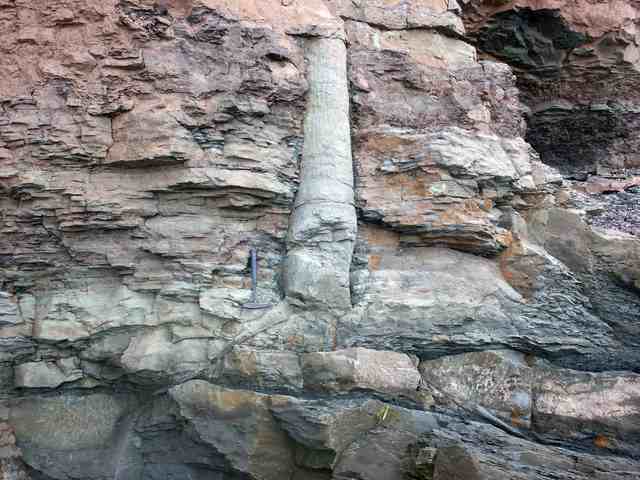
The fossil tree that yielded bones to Charles Lyell and William Dawson in September 1852 was already lying on the beach at Joggins, Nova Scotia. It had fallen from the cliff. In their paper the following year, the two geologists distinguished it from a larger tree still standing in the same rock bed. [1]
Their find was a sandstone cast of a trunk, 22 inches across. Near its base, among plant fragments, they noticed bones that did not resemble familiar fish bones. They returned the next day and broke up the remaining portion, finding jaws and teeth. [1]
Where is this place?
Joggins Fossil Centre, Nova Scotia. This map locates the town or region, not a verified exact historic event site.
Neither man claimed enough anatomical expertise to settle what they had found. They sent the collection to Jeffries Wyman at Harvard. Wyman then asked that his notes and specimens be shown to Richard Owen; John Quekett examined sections of bone under a microscope. [1]
The remains became known as Dendrerpeton acadianum, an amphibian. Joggins’s research history distinguishes this 1852 discovery from Dawson’s later reptile finds. McGill’s Redpath Museum now lists the Joggins terrestrial-vertebrate fossils among its significant collections. [3][4]
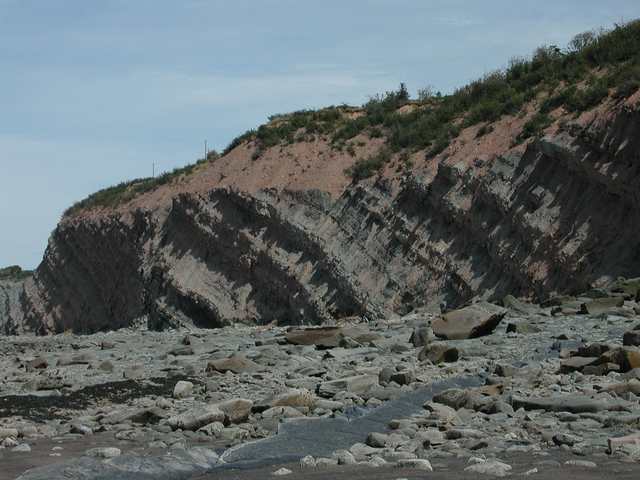
Dawson kept returning. Writing in April 1891, he described an excursion the previous summer, after several years away. The local man who had kept him informed about newly exposed fossil trees had left. With help from mine superintendent Mr McNaughton, Dawson extracted two partly exposed trees. Neither yielded the hoped-for remains. [2]
A different tree had fallen during the previous winter. Waves had removed much of the promising material from its lower part, but Dawson recovered enough to identify portions of three animals. [2]
One slab held jaws and an upper-arm bone. Dawson thought more foreleg bones probably remained inside the stone, but said he could not expose them without destroying those already visible. [2]