Dawson’s Film Cache Was Meant to Fix a Skating Rink
Old reels went into a disused pool to address uneven ice. Bringing them back to the screen required a different kind of work.
Published October 30, 2026 · Updated October 30, 2026 · 2 min read
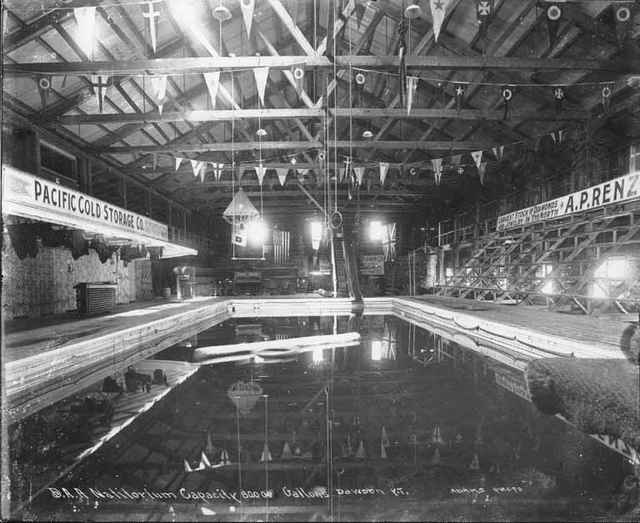
D.A.A. Natatorium interior, Dawson, probably 1902–1910, as catalogued by the University of Washington. This is an earlier pool view, not the 1929 burial or the 1978 excavation. Photograph: Edward C. Adams; University of Washington Libraries, Special Collections, PH Coll 295.35, AWC1684; digital copy via Wikimedia Commons.Photo: Edward C. Adams; University of Washington Libraries, Special Collections, PH Coll 295.35 · Source · Public domain · Proportional resize of the complete acquired Commons image to 640×523 and JPEG compression only. No new crop, retouching, recolouring or AI alteration. Commons history records a pre-existing 2019 automatic watermark crop from 768×657 to 768×627; this is a published digital version, not an unmodified scan. Photographer and collection attribution are supplied here.
In 1929, old movie reels went into a disused swimming pool in Dawson City to improve the skating surface above it. Archivist Sam Kula’s 1979 account credits the proposal to Clifford Thomson, a former bank employee and hockey-association treasurer. In that account, boards covered the pool before the arena was flooded, but the ice bulged over it. The films came from the Carnegie Library basement; earth covered the reels, and the boards went back. [1, pp.142–143]
An earlier photograph by Edward C. Adams, catalogued by the University of Washington as probably dating from 1902–1910, shows the D.A.A. Natatorium with water in its pool, roof trusses overhead and stepped seating along one side. It records the pool in use, before the films went underground. [4]
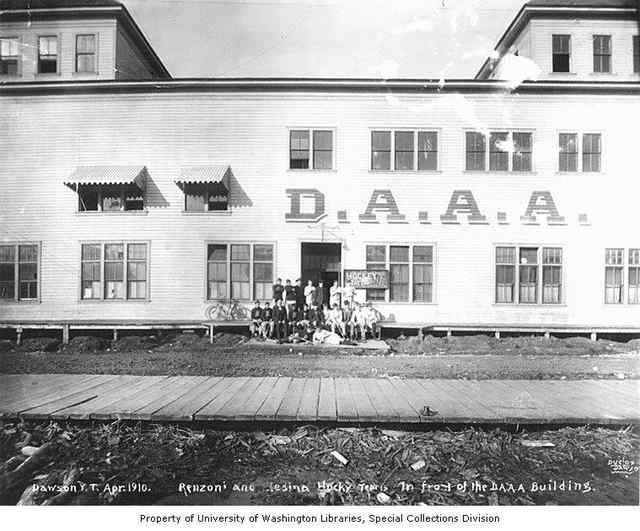
The Renzoni and Regina hockey teams outside the Dawson Amateur Athletic Association building, April 1910, as identified in the photograph’s inscription and the catalogue metadata reproduced on Commons. This predates the 1929 pool-filling work; it does not show the burial or the recovery crew. Photograph: J. E. N. Duclos; University of Washington Libraries, Special Collections, PH Coll 306.54, AWC3605; digital copy via Wikimedia Commons.Photo: J. E. N. Duclos; University of Washington Libraries, Special Collections, PH Coll 306.54 · Source · Public domain · Complete published frame proportionally resized from 759 × 630 to 640 × 531 pixels and JPEG-compressed. Photographer inscription and University of Washington collection strip retained. No crop, retouching, recolouring, watermark removal or AI alteration.
Where is this place?
Dawson City, Yukon — town context, not an exact marker for the buried pool or excavation. This map locates the town or region, not a verified exact historic event site.
The Library of Congress describes Dawson as the end of the distribution line for these films. Prints accumulated rather than travelling back. Its account records their use as pool fill in 1929 and their rediscovery during work in the summer of 1978. Cold conditions helped the material survive, but water damaged the upper layer and many recovered films were incomplete. [2]
Kathy Gates, who worked at the Dawson City Museum during the recovery, recalled in 2014 that the town lacked the facilities and expertise to restore the films. A contract with the Canadian film archives allowed her to hire a recovery crew. The material went into cold storage, and the Canadian archives shared the preservation work with the Library of Congress. Before that, Gates recalled, the recovered reels were brushed clean of dirt and rust, rewound by hand onto new plastic cores and documented. [3, pp.5–6]
Sources & further reading
The linked sources document the evidence behind the story. Source availability and image reuse rights are separate questions.
This article was developed with AI-assisted research and drafting, with source-based checks and editorial review. The publication does not claim firsthand visits or interviews unless explicitly documented.