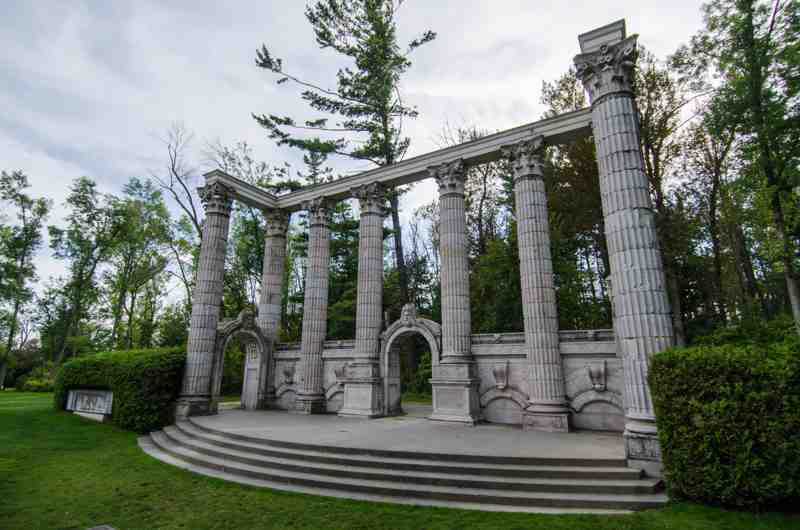
The rescued columns at Toronto’s Guild Park make a grand backdrop. A 2016 submission from groups using the park asked for less photogenic essentials, too: backstage facilities, storage and illuminated paths. [1]
That practical wish list reveals a second chapter in the life of salvaged architecture. Saving stone from demolition is one achievement. Giving it a useful role can bring a different set of demands.
Where is this place?
Guild Park and Gardens, 201 Guildwood Parkway, Toronto — geographic context. This map locates the town or region, not a verified exact historic event site.
The bank acquired a stage
The columns and arches came from the former Bank of Toronto building, not an ancient Greek ruin. Architect Ron Thom arranged the fragments into the park’s Greek Theatre, which opened in 1982. Friends of Guild Park identifies the occasion as the fiftieth anniversary of the Guild of All Arts, founded on the property by Rosa and Spencer Clark in 1932. [2]
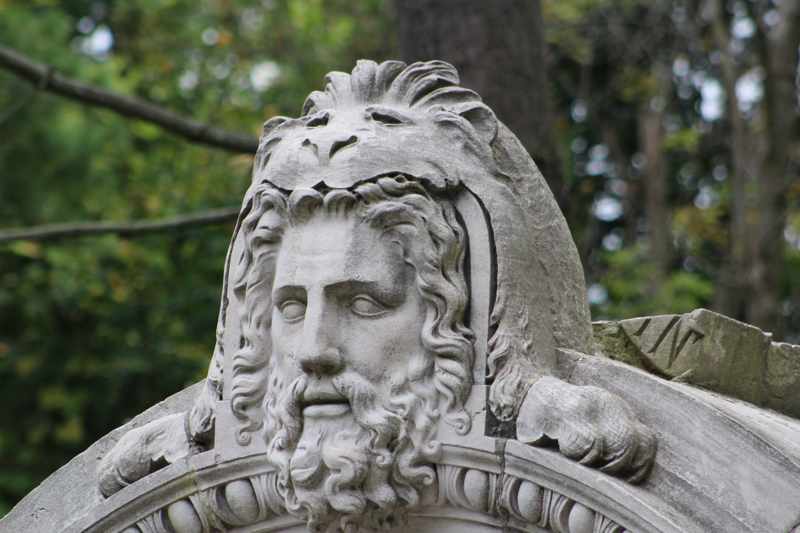
The photographs here show two scales of that reuse: a curved stage framed by imposing columns, and the carved face above an arch. Both photographs date from 2017. They record the theatre’s architectural character, not its facilities or condition today.
Guild Festival Theatre began performing at the park in 2011. The company describes its work as reimagining classics for an outdoor audience. That is a new purpose for the bank fragments, not a reconstruction of what happened inside the original building. [3]
Seats that could leave
In May 2016, four local stakeholder groups, including the theatre company and Friends of Guild Park, submitted proposals later included in the City’s community consultation report. They wanted to retain Thom’s design while adding backstage space, storage and better electrical provision. Illuminated, accessible paths were part of the request. [1]
Their seating proposal was deliberately less permanent: movable chairs would let the lawns serve other uses between performances. Preservation here meant keeping a recognisable architectural arrangement while allowing a working theatre—and a public park—to remain adaptable. [1]
These were recommendations, not a list of completed construction. Nor does the document establish what facilities are missing now.
Beyond the carved stone
The company’s production history supplies one narrower account of subsequent change. Its entry describing 2018 reports a pathway and audience lighting among the park improvements, appreciated after evening performances. It does not establish that the entire 2016 wish list was delivered, or that the submission caused the work. [4]
In 2025, the company extended the performance beyond the park itself. Its Theatre In Transit initiative brought patrons from nearby transit stops on shuttle buses carrying themed pre-show performances. The journey became part of the evening’s storytelling. This is a record of that season, not a promise of a service running today. [4]
The striking photograph is still the one of the bank columns among trees. Yet the theatre’s story also runs through a change room requested on paper, chairs intended to be put away, a path used after dusk and a bus ride turned into a scene. The fragments survived as architecture. Making them a place for theatre has required people to think beyond the fragments.