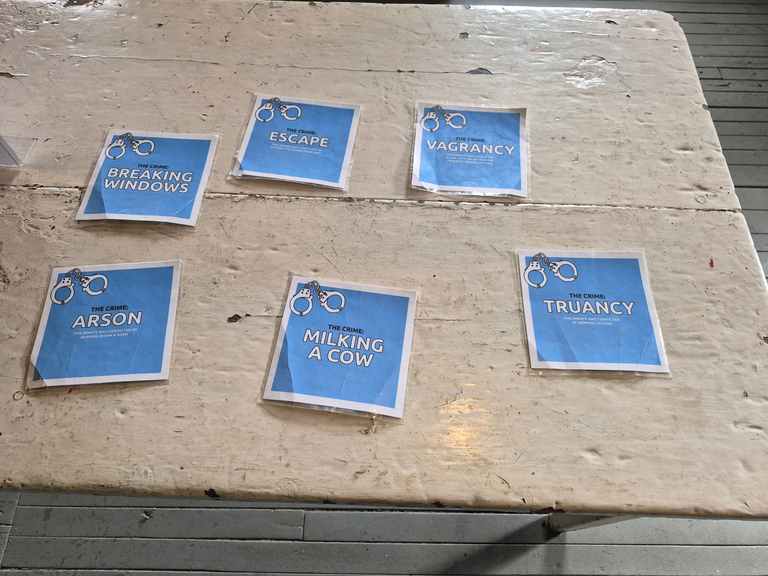
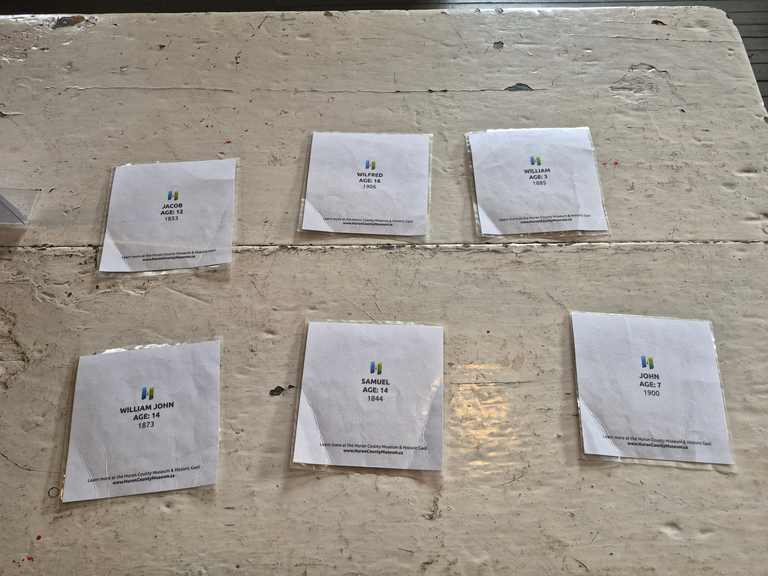
A blue card on a worn, cream-painted table reads “Milking a Cow.” Above the words is a pair of illustrated handcuffs. Turn it over and the information changes: Samuel, fourteen, 1844. A separate orange card gives the corresponding length of confinement: two weeks.
Those details appear in photographs from an October 31, 2026 visit to the Huron Historic Gaol in Goderich. The cards are part of a matching exercise. Blue faces describe offences; orange faces give sentences. Their white backs supply first names, ages and years. The format asks visitors to connect an act with a consequence. The ages make that task considerably less comfortable.
Where is this place?
Huron Historic Gaol, Goderich, Ontario. This map locates the town or region, not a verified exact historic event site.
Samuel’s card supplies no account of whose cow it was, whether permission was given or what precise charge brought him to jail. What it does establish is the museum’s pairing of that short description with a fourteen-year-old and two weeks in custody. The missing circumstances matter as much as the surprising wording: a whole encounter with the law has been compressed into three words.
Seven, three, fourteen
Another blue card names truancy. On its reverse: John, seven, 1900. His matching orange card gives one day.
The museum’s published research records a seven-year-old John Scott charged with truancy in 1900 and discharged the next day. The correspondence with the exhibit is close, although the photographed card gives no surname. An allegation of skipping school had brought a seven-year-old into the jail’s records. The brief stay does not make his age an incidental detail. Huron County Museum, “Children in the Huron Jail”.
Then there is William, three, in 1885. The blue card paired with his name says vagrancy, and its smaller text places him alongside his mother and associates the term with homelessness. The corresponding orange card gives four months.
William’s entry needs to be read alongside that explanation. The exhibit uses the language of crime and sentence, while describing a small child confined with his mother. The museum’s research describes children who entered the gaol with homeless or destitute families, and others who accompanied incarcerated parents because they had nowhere else to go. A child’s presence in the building is not, by itself, proof of an offence. Huron County Museum.
The cards bring these different routes into confinement onto the same tabletop. The matching format sets them side by side, even though a charge, a conviction and a dependent child’s stay describe different relationships to the institution. Each could end behind the same walls.
The small print changes the sentence
William John was fourteen in 1873. His blue card identifies arson, with smaller text describing the burning of a barn. An orange card displays eight days in large lettering. Beneath it comes the information that changes the scale of the punishment: the stated sentence combined eight days in jail with four years in a reformatory.
Read only the largest type and the comparison looks absurd: two weeks for Samuel, eight days for arson. Read the explanation and the eight days become one part of a much longer sentence. Leaving the Huron jail could mean going to another institution rather than going home.
Taken together, these cards offer less of a tidy ranking of punishments than they initially appear to promise. They cover different years, different circumstances and different kinds of institutional custody. They are a reason to look more closely, not a complete court record.
Another name on the wall
A separate panel introduces Ann, prisoner number 2018. According to the museum’s display, she was fifty-nine, born in Ireland and a servant by trade. She was committed on October 18, 1866 under the historical label “Insanity.” She died in the gaol on December 16, 1867.
The panel speaks in the first person, but it is a museum interpretation, not a quoted diary. It gives no cause of death. What it supplies is another life that the word prisoner alone cannot explain: a woman with an occupation and a birthplace, held under a label that tells us how the institution classified her, rather than a diagnosis we can make today.
Inside the walls that survived
Our earlier story, “A Parking Lot Nearly Changed the Shape of Goderich’s Old Jail”, followed the campaign to preserve the gaol’s enclosing walls when parking proposals threatened them in the early 1970s. The preserved layout made the institution more intelligible than an isolated historic façade would have been.
One photograph from the visit shows a stone enclosing wall rising above three picnic tables. It connects the building’s present use with the physical boundaries at the centre of that earlier story. The tabletop takes the story indoors. In another photograph from the visit, an open barred door frames a narrow cell, its pale walls and bare metal-mesh bed plainly visible. The image does not establish whether any of these children occupied that particular cell. It does show the kind of physical enclosure that an abstract duration on a card can leave out.
Four months is easy to read quickly. William’s age makes it harder to pass over. Eight days looks short until the smaller lettering adds four years elsewhere. Samuel’s card attracts attention with an unexpected description, then leaves questions that the photograph cannot answer.
Saving the gaol made it possible to keep asking those questions in the building itself. On this table, the useful act is a small one: turn the card over. The category on the front has a person on the back.