At Heart’s Content, a New Receiver Had to Wait for Paper
A recorded message helped the Newfoundland cable crew check their work. A second operator helped them reply.
Published October 31, 2026 · Updated October 31, 2026 · 2 min read
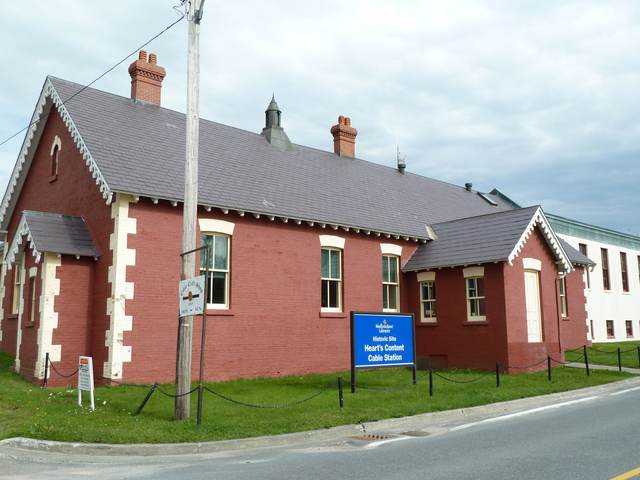
The later cable-station building, photographed 26 August 2012—not the building used for the 1874 trial. “Heart’s Content Cable Station” — Robthepiper, CC BY-SA 3.0.Photo: Robthepiper · Source · CC BY-SA 3.0 · Full-frame resize and JPEG compression; no crop or enhancement. Original EXIF explicitly sRGB with no embedded ICC; derivative labeled standard sRGB without pixel color conversion. First primary image frame, full-frame resize/compression only. Derivative remains CC BY-SA 3.0.
In October 1874, the cable station at Heart’s Content, Newfoundland, had a new receiver but still lacked the right paper to test it properly. Station chief E. Weedon’s reports, reproduced in historian Bernard S. Finn’s study, describe the awkward start of the siphon recorder. Its thin glass tube deposited ink on moving paper, leaving a trace of incoming electrical signals.[1]
The older mirror receiver made clerks read a moving spot of light as signals arrived. An 1876 Nature account described the difficulty: to correct what they had received, clerks had to ask the distant station to send it again.[2]
Where is this place?
Heart’s Content Cable Station, Newfoundland and Labrador. This map locates the town or region, not a verified exact historic event site.
By December 1874, Weedon favoured the recorder. The paper trace could be checked instead of requesting repetitions. But a lone operator lost time checking before replying. Weedon recommended two men: one reading and checking, the other ready to respond. Finn reports ten words a minute with that arrangement, against eight with the mirror or a recorder worked by one man. These were results of the station’s working arrangements, not a universal rating for the machine.[1]
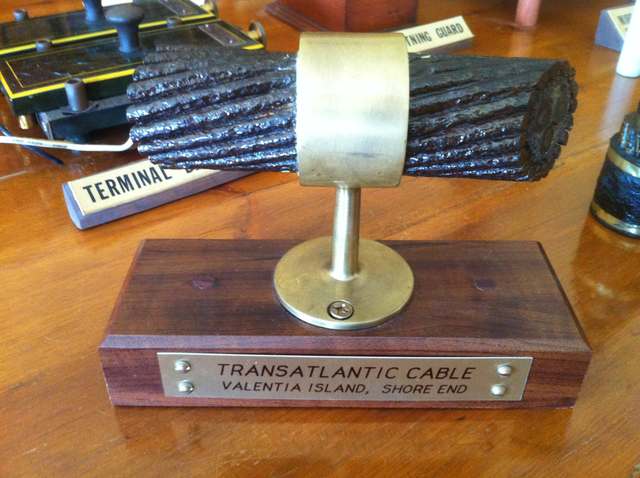
A cable sample displayed at Heart’s Content, photographed 27 May 2012. Its label identifies the Valentia Island shore end, not the Newfoundland end. “Transatlantic cable” — Jeremy Keith, CC BY 2.0.Photo: Jeremy Keith · Source · CC BY 2.0 · Full-frame resize and JPEG compression; no crop or enhancement. Original EXIF explicitly sRGB with no embedded ICC; derivative labeled standard sRGB without pixel color conversion. First primary image frame, full-frame resize/compression only.
The museum occupies the later station building: an 1875 office with a 1918 extension. Its displays follow telegraphy beyond Weedon’s trials, into a 1960s-era communications room with vacuum tubes and brass switches.[3]
Sources & further reading
The linked sources document the evidence behind the story. Source availability and image reuse rights are separate questions.
This article was developed with AI-assisted research and drafting, with source-based checks and editorial review. The publication does not claim firsthand visits or interviews unless explicitly documented.