
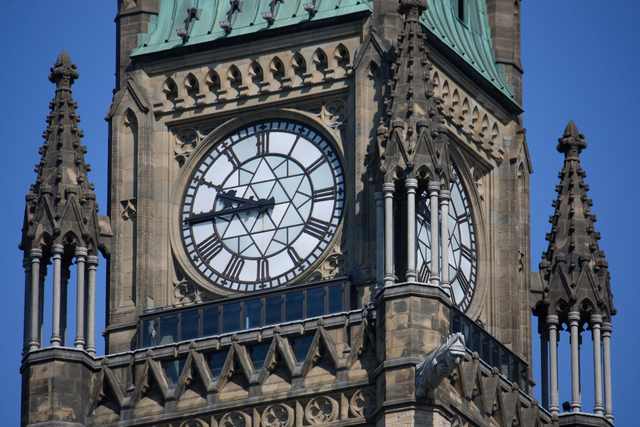
Removing bells from Ottawa’s Peace Tower meant making openings in the room used to play them. In Public Services and Procurement Canada’s account of the spring 2022 work, project technician Caitlin Rouse describes temporary hatches installed in both the ceiling and floor of the player’s cabin. They provided a route for bells and other carillon components to leave the tower. [1]
Twenty-two of the instrument’s 53 bells came down. The larger bells stayed in the belfry. Royal Eijsbouts, the Dutch bell foundry carrying out the work, digitally scanned all 53, recording their profiles. Its chief engineer, Jaap Leyten, explained that the scans would help the team prepare work on the clappers and other components. [1][2]
Where is this place?
Peace Tower, Parliament Hill, Ottawa. This map locates the town or region, not a verified exact historic event site.
The clappers—the moving pieces that strike the stationary bells—were only part of the disassembly. Workers also dismantled the keyboard and disconnected the wire transmission linking it to the bells. The House of Commons’ restoration account describes a replacement manual-and-pedal arrangement to be integrated into the heritage wooden keyboard frame, rather than an electronic instrument taking its place. [2]
The removed bells and components travelled in crates. Captain Dan Abbott, the aircraft commander identified in the PSPC account, described flying them from Trenton to Prestwick, Scotland, aboard a C-17. Prestwick was the transport hub, with cargo redistributed for onward journeys. The Dutch restoration workshop lay beyond that British transfer point. [1]