At a culvert beneath Manitoba’s Highway 17, some snakes reached the entrance and stayed there. Joshua Chan’s 1993 University of Manitoba practicum describes up to a dozen basking at its edges on sunny days during his 1992 fieldwork at Narcisse. Others hesitated, flicked their tongues and turned back. [1]
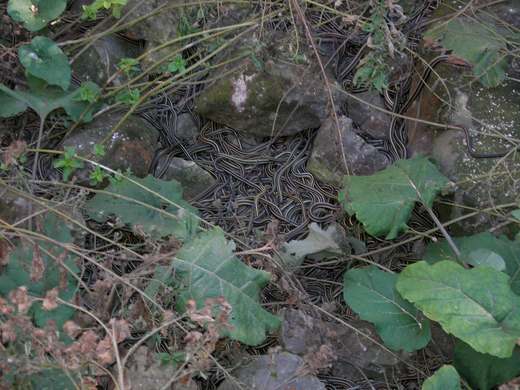
The seasonal movement brings snakes to a particular kind of shelter. Manitoba’s account of the Narcisse dens explains that underground water eroded the limestone into crevices and caverns; below the frost line, red-sided garter snakes can survive the winter. They emerge in spring to mate and return towards the dens in autumn. Four active dens form the public viewing site. [2]
Where is this place?
Narcisse Snake Dens, Manitoba. This map locates the town or region, not a verified exact historic event site.
Chan recorded 9,999 road-killed snakes along a 2.34-kilometre stretch between 31 August and 1 October 1992. Fences funnelled snakes towards the culvert, but wind sometimes lifted sections off the ground. Inside, almost all observed snakes used exposed metal edges rather than the woodchips down the middle. Fifty-four were observed leaving the far end during the sampling period. [1]
A short lighting trial used vehicle signal lights and an emergency lamp powered by a car battery. Chan noticed little change in behaviour—not proof that lighting could never matter. Some snakes used the culvert as shelter at sunset. [1]
The province’s 2000–2001 conservation report describes a later expansion of the crossing effort. A committee included area residents and Manitoba Transportation and Government Services. Manitoba Hydro had installed several culverts, and snakes using them were being counted. More culverts had been obtained for possible installation in June 2001. [3]