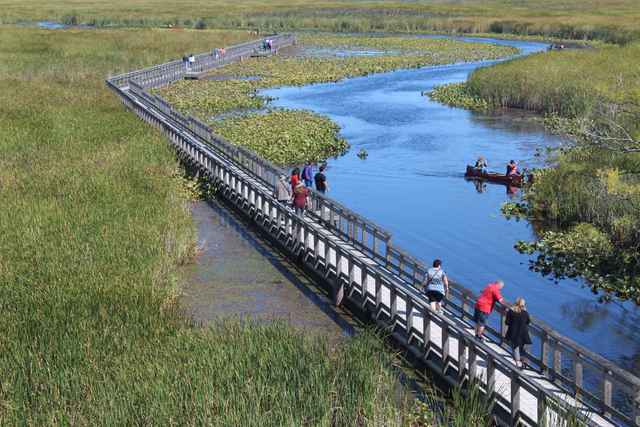
A gravel path disappeared when Point Pelee renewed its Marsh Boardwalk Area. The old route and boat launch had been there since 1972. In its July 2019 account of the completed work, Parks Canada explained the removal: it wanted turtles to nest in the re-established wetland habitat rather than near the parking lot. A new boardwalk connected the lot to the lookout tower. [1]
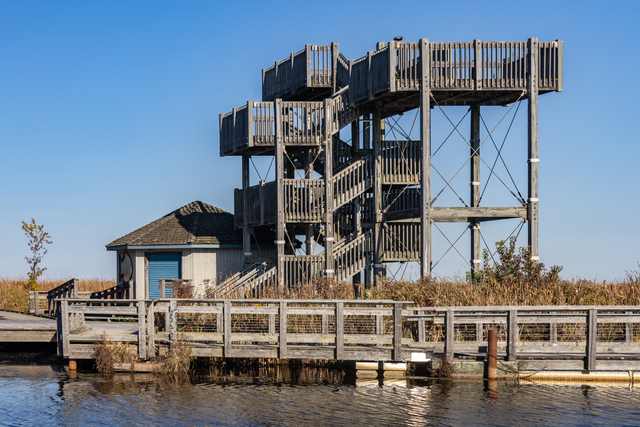
The project also replaced all 500 metres of the stationary boardwalk section, then 58 years old, with a wood-and-metal design. The tower received slip-resistant steps, and canoeists and kayakers got a new launch. The turtle measure was part of that visitor-infrastructure renewal, not simply a repair to the planks. [1]
Where is this place?
Marsh Boardwalk, Point Pelee National Park, Ontario. This map locates the town or region, not a verified exact historic event site.
Keeping routes open for wildlife became a task within the marsh itself. Parks Canada’s account of the restoration programme planned for 2020–2023 describes two aquatic machines working together: one would cut through dense invasive cattail mats; the other would collect the material and place it in approved piles along their edges. Some piles were intended as nesting and basking habitat. [2]
Dense wetland vegetation can also conceal dry ground. In the public abstract of a research note published in 2026, Trent University’s Meghan Ward reported finding two desiccated juvenile turtles during vegetation surveys at Point Pelee: a snapping turtle on a dry cattail mat in 2022 and a painted turtle in a reed patch without surface water in 2024. Ward suggested that such isolated patches might restrict access to water or cooler places in hot, dry periods. Those observations do not measure the outcome of the 2019 path removal. [3]
The machinery plan included its own precautions. Staff would survey for wildlife before working and avoid peak bird breeding, fish spawning and turtle hibernation periods. They would also start the machines several times before proceeding, using the noise to encourage animals to move away. [2]