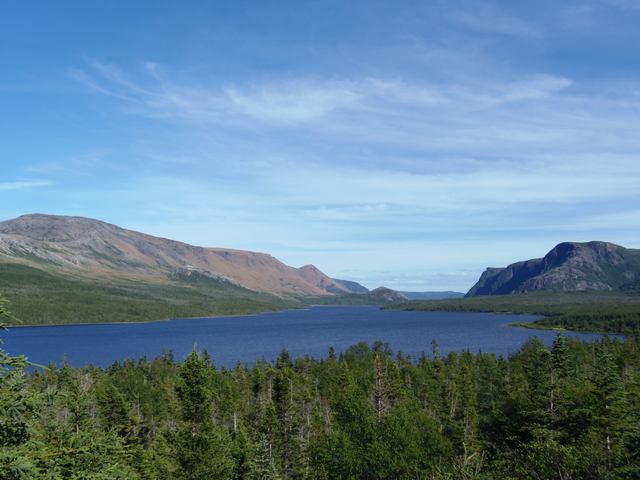
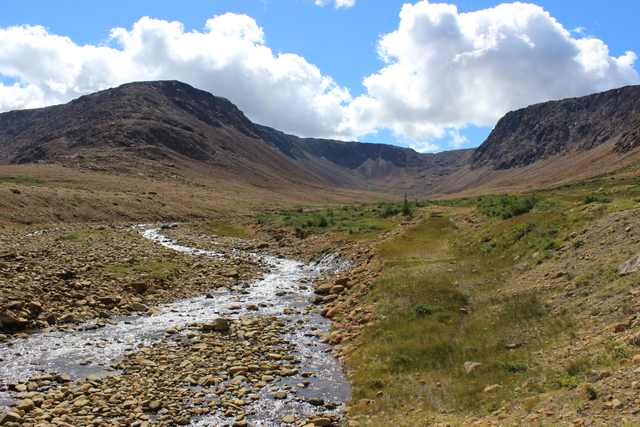
From across Trout River Pond, the Tablelands look like a break in Newfoundland’s greenery: brown slopes rise above a forested shore. A closer photograph, beside a stream, complicates that first impression. Green patches run between the stones. The landscape is sparsely vegetated, not empty.
The brown is a surface story
A 2012 geological field guide describes the Tablelands’ mantle rocks as mainly peridotite, rich in iron and magnesium. Their weathered brown colour comes from oxidation of iron; fresh surfaces are typically dark green, reflecting minerals such as olivine and pyroxene. The familiar colour of the hills is therefore not a complete description of the rock. [1]
Where is this place?
The Tablelands, Gros Morne National Park, Newfoundland and Labrador, Canada — broad landscape context, not survey plots. This map locates the town or region, not a verified exact historic event site.
Chemistry also helps explain the vegetation. The guide describes rock compositions that inhibit plant growth in the soils above them. Across the glacial valley leading toward Trout River, relatively bare Tablelands rock contrasts with the vegetation-covered rocks of the Little Port Complex. Two neighbouring slopes need not provide the same growing conditions. [1]
Geologist Andrew Kerr’s 2019 account brings that contrast down to the scale of a walk. Along the old-road section of the Tablelands trail, he describes large brown-weathering peridotite blocks derived from the cliffs, some with serpentine minerals coating fractures. At Winterhouse Brook, the watercourse contains abundant ultramafic blocks. A photograph of stones beside a stream cannot, by itself, identify every mineral or every rock’s origin. [2]
A survey needed more than a species list
Lichen researcher Michele Piercey-Normore’s December 2015 field report adds another distinction. Native serpentine rock supported relatively few lichens; glacial erratics—rocks delivered from elsewhere—offered different material that lichens colonised more readily. Soil accumulated in cracks provided another setting. The survey considered these contrasting surfaces rather than treating the brown landscape as one habitat. [3]
Working with park permission on 19–20 September, the group collected more than 200 specimens across four locations. Its question was not simply whether lichens survived there. Were those found on peridotite restricted to it, or did they also occur on other surfaces? Piercey-Normore presented that as an investigation, not a settled answer. [3]
The photographs here show the setting, not the survey specimens. They cannot name a lichen or establish what it tolerates. The field report’s useful correction is smaller: even in a seemingly uniform expanse of bare stone, where an organism grows matters. [3]