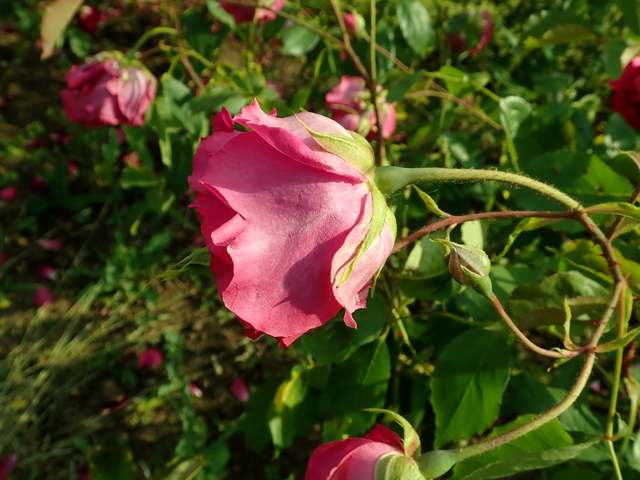
A rose surviving on Alcatraz mattered to a garden thousands of miles away. ‘Bardou Job’ had been among the original roses in the Castle Rosery at St Fagans, Wales. When the museum recorded its rediscovery in its 2000–01 annual report, the unexpected location was the garden of a former island prison in San Francisco Bay. [1]
The connection turns a familiar preservation story inside out. Alcatraz did not simply receive plants to make its historic gardens look complete again. A plant that had persisted there also helped another garden recover something it was missing.
Where is this place?
Alcatraz Island, San Francisco Bay — public island location, not the precise historic rose position or a private collection address. This map locates the town or region, not a verified exact historic event site.
First, find out what survived
The Golden Gate National Parks Conservancy dates the abandonment of Alcatraz’s gardens to the prison’s closure in 1963. In 1989, members of the Heritage Rose Group visited, inventoried surviving roses and took cuttings for propagation. The work was not merely a search for attractive flowers: identifying what remained could preserve a particular cultivated variety. ‘Bardou Job’ was among those survivors. [2]
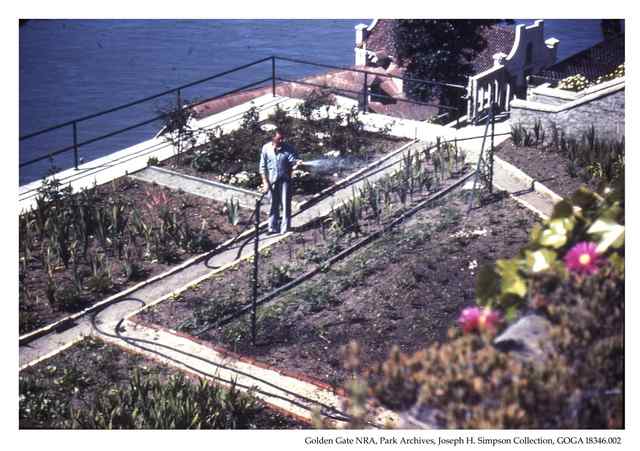
An archival photograph from the 1950s shows cultivated beds and a person watering them, with the bay beyond. It supplies a glimpse of the tended landscape before closure, not a portrait of the person who planted ‘Bardou Job’. Nor does it identify that rose among the beds. Those are different kinds of evidence, and a garden photograph cannot supply them automatically.
The question of survival also appears in the Conservancy’s May 2015 inventory. It gives each entry a survivor flag. ‘Bardou Job’, also listed as the Alcatraz red climber, is marked yes; many other roses are marked no. Its listed introduction year, 1887, concerns the cultivar—not a documented planting date on the island. A restored garden can contain both inherited plants and later additions without making them the same historical thing. [3]
A record in Wales, and plants to grow
The Welsh museum’s annual report identifies ‘Bardou Job’ as one of the Castle Rosery’s original roses. A later account explains how living material followed the rediscovery. In April 2020, senior garden conservator Juliet Hodgkiss recalled that rose enthusiasts propagated the Alcatraz plant and sent roses to the museum. Her account describes propagation and transfer, but does not give an arrival year. [1][4]
That is enough to establish the useful connection without turning it into a claim that Alcatraz held the world’s last example. The photograph of ‘Bardou Job’ accompanying this article was taken at a rosarium in Germany in 2019. It illustrates the named cultivar elsewhere, not the island’s surviving plant or a documented descendant of it.
The important journey was not simply from one flowerbed to another. A name in a garden’s history became something gardeners could grow again. Alcatraz’s surviving rose was therefore more than an ornament to restore in place: through identification and propagation, it could help repair another living collection.