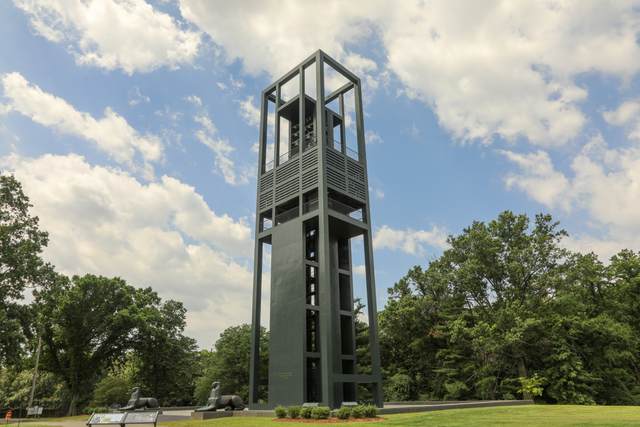
The smallest of three bells added to the Netherlands Carillon carried Eleanor Roosevelt’s name. It weighed twelve kilograms. The largest newcomer honored George C. Marshall; the third honored Martin Luther King Jr. At this Arlington memorial, weight was not a simple measure of how much a dedication had to say. A Dutch carillon association’s account of the 2021 additions makes the contrast unusually concrete. [1]
The three dedications put reconstruction, human rights and civil rights together inside an instrument already associated with wartime liberation. Their different sizes make an instructive contrast, though not a ranking of the lives they commemorate. A memorial can be enlarged by a relatively small object. [1, 2]
Where is this place?
Netherlands Carillon, Arlington, Virginia — public monument, not the 1952 Meridian Hill Park ceremony site or an exact photo viewpoint. This map locates the town or region, not a verified exact historic event site.
A gift that arrived in stages
The carillon began as Dutch gratitude for American assistance during and after the Second World War. In April 1952, Queen Juliana presented President Harry Truman with a small silver bell as a token of the instrument still to come. The Truman Library’s recording catalogue places the ceremony at Meridian Hill Park in Washington—not at the tower’s eventual Arlington site. [2, 3]
Forty-nine bells followed in 1954, initially in a temporary West Potomac Park tower. The permanent installation in Arlington was dedicated on May 5, 1960. A fiftieth bell joined the story in 1995. The embassy’s timeline records its presentation at the White House in February; the National Park Service records its dedication in May. Those were different events, not competing dates for one ceremony. [2, 4]
Even the earliest presentation gave small bells a political meaning. In the speech reproduced by the National Park Service, Juliana asked listeners to consider voices whose lack of weight left them unheard. This was an argument about listening, not a technical explanation of the instrument. [2]
More than returning the old bells
The later project repaired an existing instrument and added to it. The Dutch association reported that Royal Eijsbouts had renovated and retuned the fifty bells, with two small new bells and one large one to join them. Its account identified the twelve-kilogram Roosevelt bell with her human-rights advocacy. [1]
The embassy dates the casting of the three additions to April 2020. All fifty-three bells returned to the United States in April 2021. Before the newcomers disappeared into the tower, they were displayed at the embassy in May; the Marshall bell was hoisted later that month. Reopening and rededication followed on May 5, 2022. Casting, display, installation and public reopening were separate steps. [4]
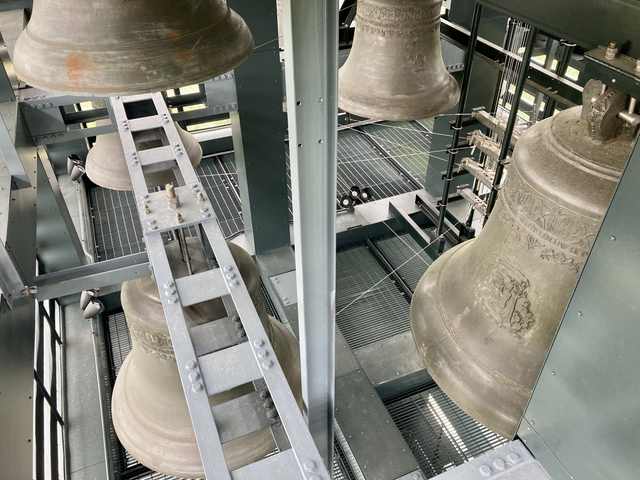
The 2022 photograph from within the open tower brings the instrument down to visible working parts: bronze bells, steel supports, wires and levers. From outside, the tower reads as a tall, open frame. The close view reveals the objects and connections inside it, though it does not identify the three new bells.
Read beside Juliana’s earlier appeal, the small Roosevelt bell offers a connection without proving a deliberate design reference. Restoration kept the instrument. The additions gave its commemorative story more people to name—and showed how a twelve-kilogram contribution could carry a substantial part of that story.
Reporting note: This article draws on published institutional records and photographs, not a site visit, interview or listening test.