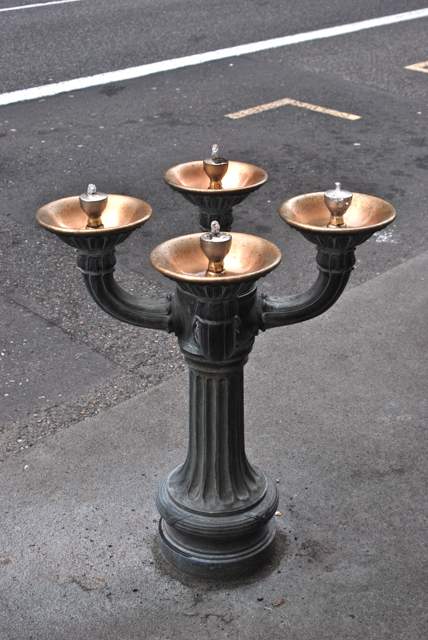
Four bowls reach out from a dark stem in Steve Morgan’s photograph of a Benson Bubbler at Broadway and Washington Street. Water rises from each little nozzle without anyone pressing a button. It looks like a generous piece of street furniture with a simple operating principle: keep going. Portland’s maintenance history tells a more selective story. The city could preserve the familiar shape while changing how much water passed through it.
The Water Bureau dates the original gift to 1912, when Simon Benson donated $10,000 for twenty fountains designed by A. E. Doyle. It treats the familiar stories about Benson’s motives—discouraging saloon visits or helping a thirsty child—as folklore, not a settled account. The four-bowl form is less ambiguous: the bureau distinguishes it from Portland’s similar single-bowl fountains. [1]
Where is this place?
Benson Bubbler at SW Broadway and Washington Street, Portland — lead photograph location; not a current drinking-water or service guide. This map locates the town or region, not a verified exact historic event site.
Even four bowls were not always assured. Writing for The Oregon Encyclopedia, Zeb Larson describes a period of disrepair when some fountains were reduced to two. He credits longshoreman Francis Murnane’s 1958 restoration campaign, supported by writer Stewart Holbrook, with helping prompt the city to refurbish sixteen fountains and recast four. That account makes the familiar silhouette something people argued for, rather than something that simply survived untouched. [3]
Later changes worked on the supply instead. In a brochure marked May 2013, the Water Bureau records narrower feed lines in 1995, timers in 2000 and small flow restrictors in 2005. It credited the last change with reducing water use by forty percent without altering the fountains’ appearance. That is the bureau’s historical assessment, not a new measurement of every fountain today. Its current history page also records the 2005 devices. [1, 2]
The brochure also describes restoring the weathered patina after people polished it away. An old-looking exterior was deliberate, not simply a sign of neglect. Neither photograph here shows internal changes: these are views from 2015 and 2017, not a before-and-after water-use test. [2]
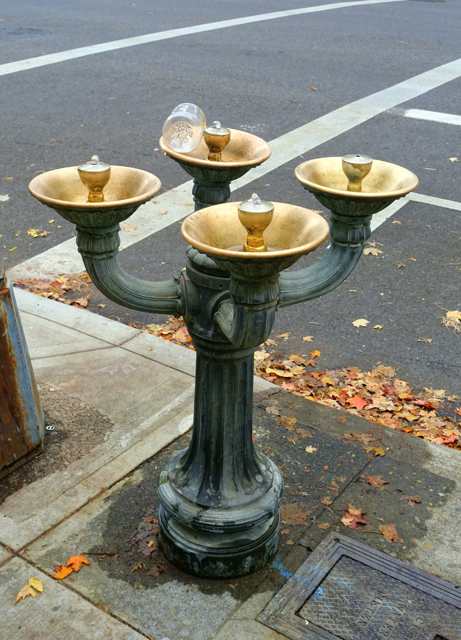
Nor is a bubbler a little recirculating pool. The bureau says the water is fresh, rather than recycled, and notes that cold or windy conditions can require shutdowns. Those are reminders that a historic fountain is still equipment to be managed, not an ornament exempt from weather and supply. Keeping the four bowls did not require keeping every old operating habit. [1]