Work on a red maple near Prospect Park’s Lullwater Bridge was postponed in 1967. A tree specialist wanted to see whether planned retaining-wall work and lake dredging would injure its roots. Its allocation went instead to an American elm at the Nethermead, according to the 1968 guide Tree Trails in Prospect Park. [1]
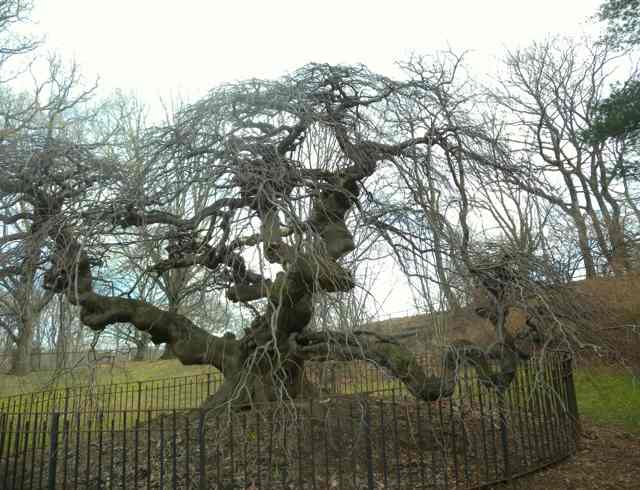
The fund paying for the work carried another tree’s name. Prospect Park’s Camperdown elm, planted near the Boathouse in 1872 as a gift from A. G. Burgess, had become the focus of a rescue campaign. During a park walking tour, participants discovered that its trunk and large horizontal limbs were hollow. The Friends of Prospect Park appealed to members for money for professional care, as Camperdown Fund director M. M. Graff later recalled. [2]
Where is this place?
Camperdown Elm, Prospect Park, Brooklyn. This map locates the town or region, not a verified exact historic event site.
Marianne Moore helped make the elm famous. Her poem in The New Yorker and an appeal in The New York Times brought attention and contributions. Graff’s recollection, added to the 1972 edition of the Prospect Park Handbook, also records Moore’s request for gifts to the fund instead of funeral flowers. Those donations became the beginnings of a remembrance fund intended to restore a tree each year. [2]
The earlier rescue programme had already reached beyond its namesake. Tree Trails, by George Kalmbacher and Graff, records treatment of four trees in the Camperdown Fund’s first year. A many-trunked European hornbeam had been pruned and fertilised. A European larch received pruning and feeding. The guide described the Camperdown itself as reinforced, pruned, filled and fed. [1]
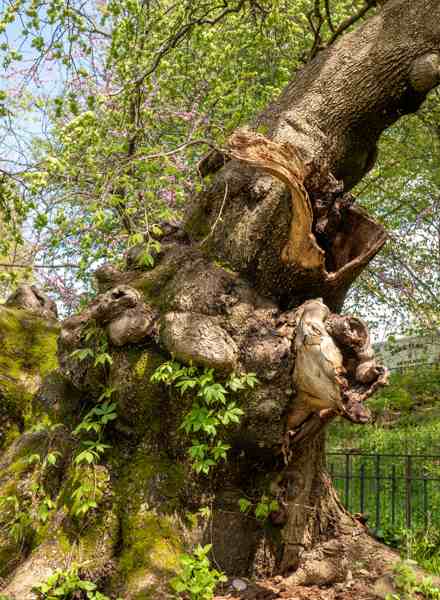
The American elm that received the maple’s allocation was given deep-root feeding in autumn 1967. Its pruning still had to wait: the fund’s first-year resources had not stretched that far. The guide listed that work as a goal for 1968. [1]