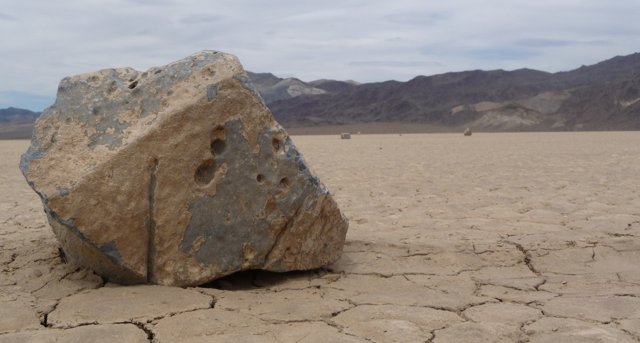
The National Park Service would not let the researchers instrument Racetrack Playa’s native stones. For an experiment set up in winter 2011, the team brought in similar rocks; volunteers helped quarry them. [1]
Inside each imported limestone block, a bored cavity held a GPS logger that recorded its position and temperature once an hour. A magnetic trigger lay buried beneath the stone. Movement disengaged the logger from the buried magnetic trigger, switching recording to once a second. [2]
Where is this place?
Racetrack Playa, Death Valley, California. This map locates the town or region, not a verified exact historic event site.
There were fifteen instrumented rocks, but only three fully recorded their initial movements. Some packages flooded, and batteries ran out before later journeys. [2]
On 4 December 2013, two test stones roughly 153 meters apart started moving within six seconds of one another. Their logged journeys lasted sixteen minutes: one traveled 65.6 meters, the other 64.1. [2]
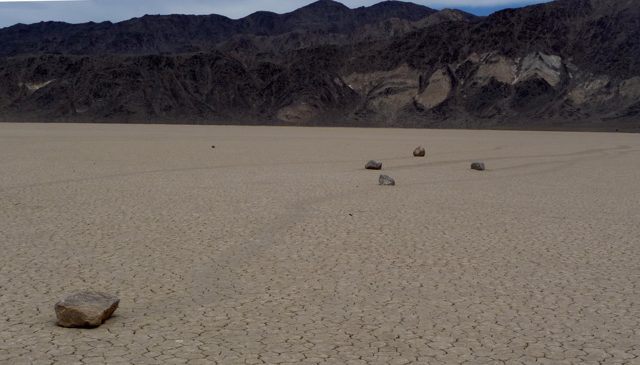
Those measurements preceded Richard and James Norris’s eyewitness observations on 20 and 21 December. The study documented thin floating ice breaking into panels, driven by wind and flowing water, that pushed stones across the wet lakebed. Fresh tracks could remain hidden under the ice-covered, muddy water until it moved away. [2]