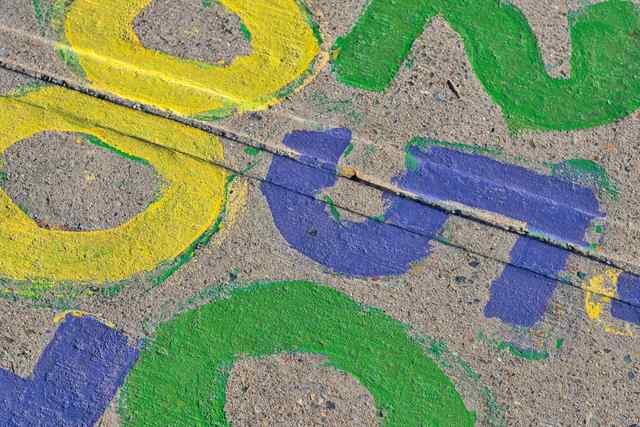
A bridge can remember a joke in two quite different ways: with something hard to remove, or with something people keep putting back. On the Harvard Bridge between Boston and Cambridge, the smoot has had both. A titanium plaque commemorated the unusual unit of distance. Paint carried it along the sidewalk.
Chris Rycroft’s November 2021 photograph makes the second kind of memory tangible. Yellow, green and purple overlap on rough concrete. The edges are not those of a precision instrument. The picture shows a surface that has received attention, not a ruler preserved untouched since the joke began.
Where is this place?
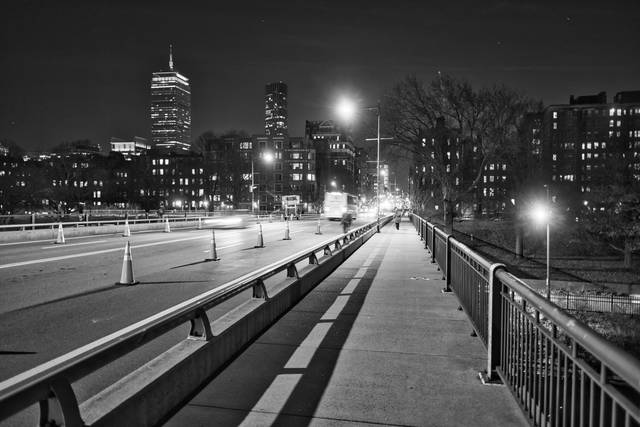
Harvard Bridge, Massachusetts Avenue over the Charles River, Boston–Cambridge, Massachusetts — bridge context, not an exact plaque or paint-mark location. This map locates the town or region, not a verified exact historic event site.
A measurement entered the engineering record
In autumn 1958, members of MIT’s Lambda Chi Alpha fraternity used fellow member Oliver Smoot as a human measuring stick. The episode eventually found its way into a document concerned with considerably less whimsical matters: the Historic American Engineering Record’s history of Harvard Bridge, transmitted in 1987. Its account mentions the smoot markings and says fraternity pledges repainted them every six months. [1]
That is evidence of a practice recorded then, not a maintenance timetable for today. The same engineering history describes the replacement of wooden sidewalks with concrete in 1924, and another sidewalk replacement in 1962. The joke belonged to a working crossing whose materials were changing. Keeping its memory did not require keeping every surface that had first carried it. [1]
Making a more durable reminder
There was also work to do away from the pavement. On 4 June 2009, a titanium anniversary plaque was unveiled at the Cambridge end of the bridge. Reporting the next day, MIT’s student newspaper, The Tech, identified the maker as Ilan E. Moyer, a 2008 graduate, assisted by the MIT Hobby Shop. An aluminium prototype had been presented to Smoot the previous October and was destined for the MIT Museum. [2]
The article described more than a design: it followed the plaque through machining and installation in a concrete base. Moyer’s concern with secure attachment gave the commemoration a material problem to solve. A memorial had to remain where people could encounter it. [2]
Yet a plaque could explain the smoot without reproducing the experience of meeting another painted mark farther along the sidewalk. One concentrated the story in a durable object; the other spread it through the walk.
Paint still needed people
In an October 2023 first-person post for MIT Admissions, student Emiko P. described joining students and alumni to repaint the markings at night. She recalled faded numbers receiving fresh colour, and an older participant leaving her to choose which letters to paint green. Her account presents the task as sociable and imperfect, rather than a painstaking restoration to a single original finish. [3]
This was her experience in 2023, not our observation or proof of an uninterrupted schedule. It nevertheless supplies something the anniversary plaque cannot: a record of people returning to do the work. [3]
Taken together, the engineering history, the plaque’s fabrication and that later painting account suggest two different forms of care. One protects an object; the other renews a shared activity. The Harvard Bridge’s joke did not survive only because someone decided it deserved a monument. Its painted form also needed people willing to pick up a brush again.