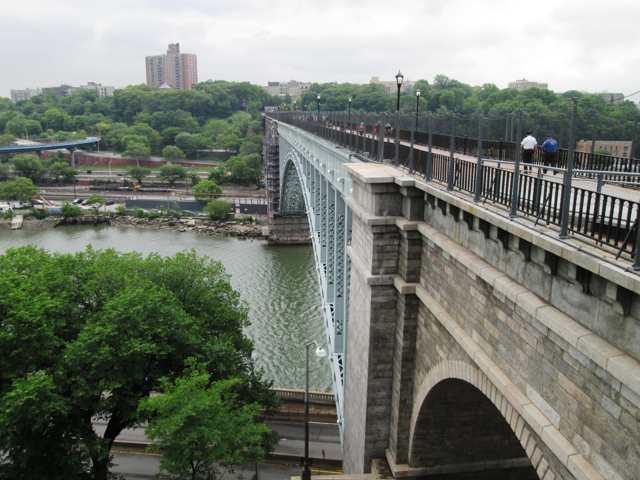
The steel arch and stonework are easy to see in Beyond My Ken’s photograph of High Bridge on 9 June 2015. The old water pipe is not. That concealment mattered when New York restored the crossing between Manhattan and the Bronx: according to LiRo-Hill, which provided construction inspection and environmental engineering, the pipe needed stabilization and conservation before significant work could begin on the outer bridge. Bringing people back required attention to infrastructure they would not see. [1]
High Bridge entered service in 1848 as part of the Croton Aqueduct. It carried water across the Harlem River, with pipes beneath the deck. A walkway later made the crossing a place for people as well as water; LiRo-Hill dates its opening to 1864 and the aqueduct’s end of service to 1958. The restoration did not have to make both uses return together. [1, 2, 3]
Where is this place?
High Bridge over the Harlem River, New York City — historical site context, not a current access guide. This map locates the town or region, not a verified exact historic event site.
The familiar outline was already a record of change. Friends of the Old Croton Aqueduct describes John B. Jervis’s original fifteen masonry arches, then the replacement of five with a single steel arch in 1927–28. Public opposition had defeated a proposal to remove the bridge as an obstacle to navigation. The mixed stone-and-steel structure in the photograph is not simply the 1848 design frozen in place. [3]
Restoration worked through those layers rather than disguising them. The city’s Department of Design and Construction reported repairing the aqueduct piping over the steel span, rebuilding the Manhattan gatehouse with traditional techniques, and bonding the brick paving with natural cement. Those choices sat alongside new technology, including LED lighting beneath the bridge. Historic character was something to work on selectively, not a requirement that every component remain untouched. [2]
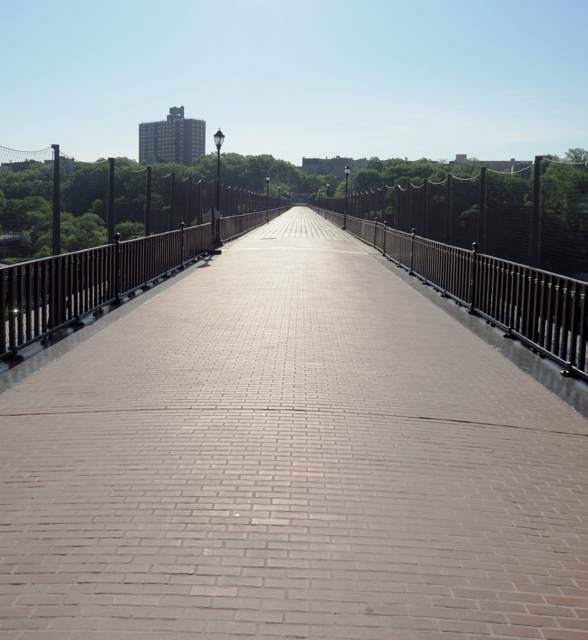
The city marked the reopening on 9 June 2015. Its announcement described a hand-restored brick walkway, new safety railings, improved access and renovated steel and masonry. RoySmith’s 2017 photograph looks along that pedestrian surface toward the Bronx: brick, railings and lamps, with the former water route out of sight. Neither photograph documents the pipe’s condition or the work inside it. [4]
These are accounts from the city and restoration participants, not a new engineering inspection. They describe a crossing whose future was not confined to its next use. The pipe had lost its water-supply task, but not its place in the bridge.