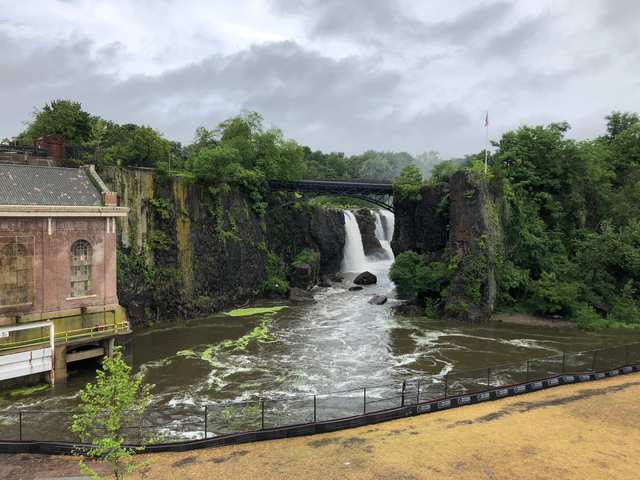
Paterson’s Great Falls has a number for the view. A National Park Service case study, updated in August 2026, reports 400 cubic feet of water per second passing over the falls during weekend daylight hours under arrangements developed through hydropower relicensing. [1]
That makes the view more than scenery beside a machine. It is one of the things the water is being asked to provide.
Where is this place?
Paterson Great Falls National Historical Park, New Jersey, USA — public-park context, not powerhouse interior access or a water-release schedule. This map locates the town or region, not a verified exact historic event site.
Famartin’s 2018 photograph puts the brick powerhouse at the left edge of the gorge. The building is not simply an exhibit about vanished industry: the NPS case study describes a generating project operating alongside the national historical park. [1]
A different route down
Water once reached Paterson’s mills through a three-tiered raceway network. Wheels and turbines supplied mechanical power through shafts, gears and belts. A central electricity plant offered a different geography: wires could carry power beyond the channels that had determined where factories clustered. The hydroelectric plant was built beside the falls in 1912–1914. [2]
Preserving that building did not mean keeping all its original machinery in service. During the 1986 renovation, three turbines were replaced; the fourth was retained, inoperable. The plant reopened that December. Industrial continuity involved changing the equipment inside the historic walls. [2]
Keeping water in the picture
Concern about the visible waterfall long preceded the national park. A 1977 engineering-landmark dedication booklet warned that a proposed upstream diversion could damage the falls’ scenic character and undermine efforts to revive the surrounding district. The same booklet described plans to reactivate the hydroelectric plant. Its authors were defending both a working landscape and a view—not simply choosing one over the other. [3]
The park’s later general management plan identified a more precise gap. Existing requirements for continuous flow to the power canals did not address aesthetic flows over the falls. The plan called for work on the timing, duration and quantity of water, alongside an aesthetic-flow study and participation in relicensing. [4]
The 2026 NPS account reports an agreement to improve those scenic flows while retaining electricity generation. It is an agency account of the arrangements, not a live measurement or a promise of an identical waterfall on every visit; rain and drought also shape the river. [1][4]
In firoz-ansari’s 2016 photograph, the powerhouse’s tall windows share the frame with falling water.
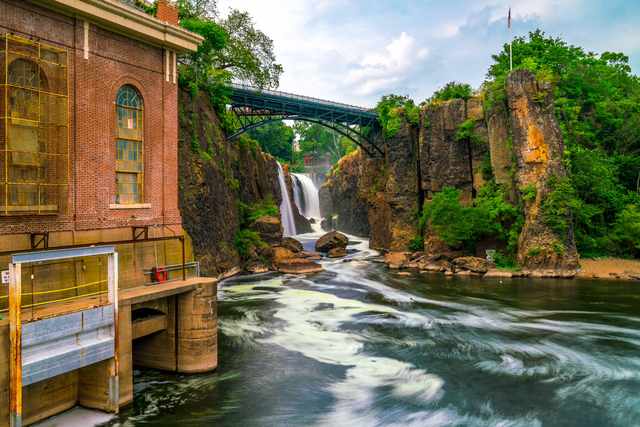
Saving that scene requires more than keeping the brickwork upright. It also means deciding how the river will move through it.