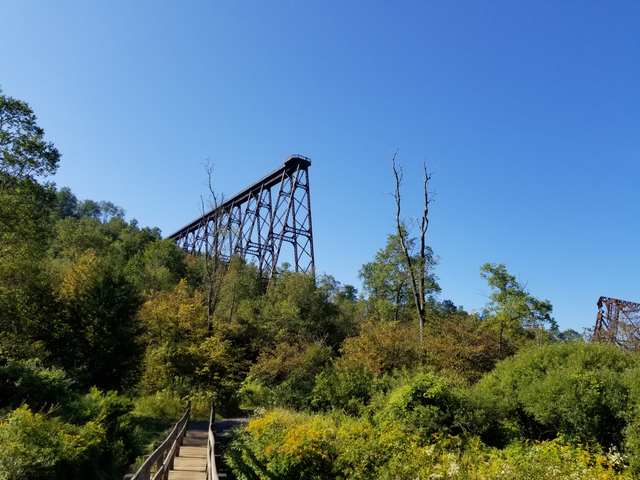
In 1900, workers rebuilt Pennsylvania’s Kinzua Viaduct in steel to carry heavier trains. Its height and length stayed the same, but its weight more than doubled: from about 3.1 million pounds to 6.7 million. The old anchor bolts remained. [1][2]
That last detail appears in the state park guide’s account of the investigation after the bridge’s collapse. The iron structure completed in 1882 had been replaced, the guide explains, except for anchor bolts reinforced with collar-couplings. The newer bridge still depended on connections inherited from its predecessor. [2]
Where is this place?
Kinzua Bridge State Park, Pennsylvania. This map locates the town or region, not a verified exact historic event site.
Trouble was recognised before the storm. In 2002, Pennsylvania’s Department of Conservation and Natural Resources barred excursion trains from the viaduct, then closed it to pedestrians. Inspectors had found steel sections rusted through. Restoration work began in February 2003. [1]
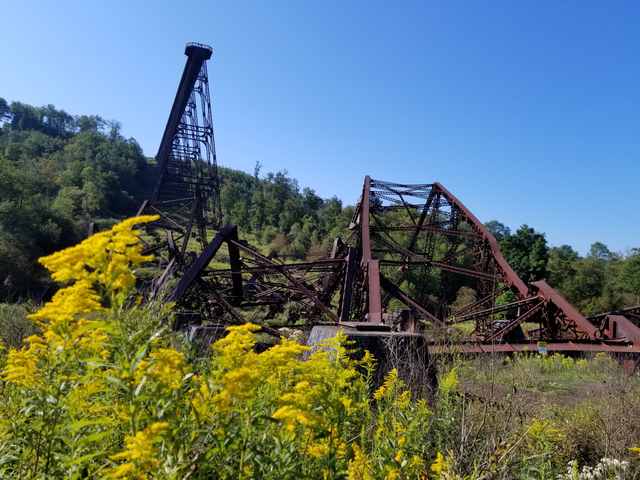
On 21 July that year, a tornado struck. National Weather Service surveyors examined damage and interviewed residents and emergency-management officials. They estimated winds at 100 miles an hour and classified the tornado as F1 on the Fujita scale. [3]
The park guide reports that hidden fractures had developed in the collar-coupling assemblies and anchor bolts, leaving them too weak to withstand the tornado’s winds. It counts eleven fallen towers. [2]
The surviving section later became a pedestrian skywalk, opened in September 2011. Six original towers were restored for it. Among the changes beneath the new walkway were new anchor bolts. [1][2]