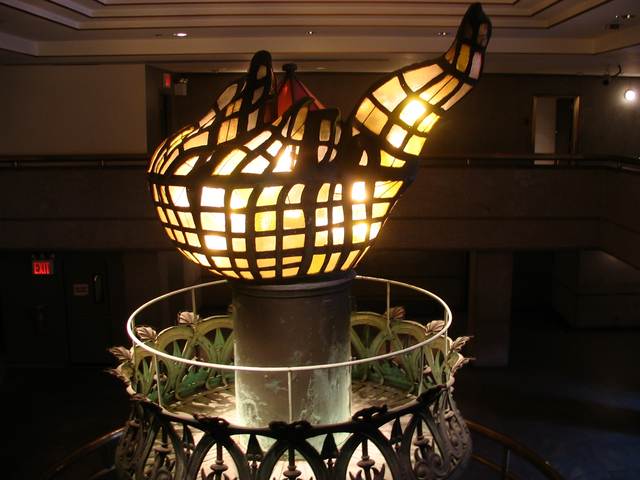
In an old National Park Service photograph, the Statue of Liberty’s detached flame glows through irregular glass panels. Its dark ribs make it look almost like a giant stained-glass lantern. This was the original torch, displayed inside the monument’s pedestal—not the solid-flamed replacement raised above New York Harbor in the 1980s.
The glass is a clue to a practical argument inside a famous symbol. Should a sculpted flame merely look bright, or should light actually come out of it? The old torch carries the marks of repeated attempts to answer that question.
Where is this place?
Statue of Liberty Museum, Liberty Island, New York — public museum location, not a precise historical camera position. This map locates the town or region, not a verified exact historic event site.
Cutting light into copper
The Statue of Liberty–Ellis Island Foundation traces the changes back beyond the statue’s dedication. Bartholdi’s 1874 conception called for a solid copper flame, gilded to catch daylight. By the dedication in 1886, two rows of openings had been cut into the torch so that it could be lit from within. [1]
More changes followed. In 1892, a glass band replaced one row of openings and a colored-glass skylight was added. In 1916, numerous pieces of copper gave way to amber glass. The flame had become a substantially different object from the one the sculptor first imagined. [1]
That last alteration was already part of the official historical record before the centennial restoration. New York City’s 1976 landmark designation report credits sculptor Gutzon Borglum with the 1916 redesign. Its description of yellow-tinted glass helps explain what the photograph shows: the torch’s patchwork appearance was not simply the result of age. It had been made that way. [2]
A replacement, and a retained object
By the 1980s, water had severely damaged the flame and upper torch. The National Park Service’s restoration history describes their replacement with a replica based on Bartholdi’s original design, including gilding. The workmen pictured here stand beside that new, solid-flamed torch before it was lifted into place. The original photograph is black and white; it cannot show the color of the gold. [3]
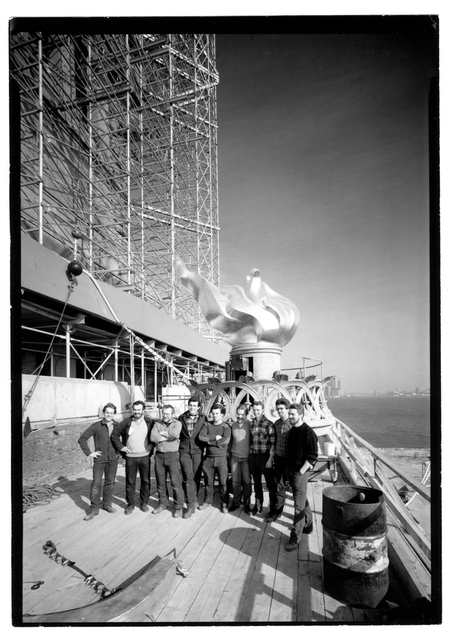
The old torch was removed in 1984. Its replacement was installed in November 1985 and formally dedicated the following July. Meanwhile, the altered original became a museum object in the pedestal. Restoring the silhouette overhead did not require discarding the evidence of how it had changed. [4]
Another move, only 470 feet
In November 2018, engineers disassembled the old torch for a much shorter journey. A hydraulically stabilized transporter carried it 470 feet across Liberty Island; a crane then lifted it into the new museum building. The National Park Service documented the move while construction was still under way. [4]
The journey also addressed a problem of access. In that 2018 announcement, the Foundation’s then-president, Stephen Briganti, estimated that only one-fifth of island visitors could enter the monument and see the old torch. That was a historical estimate, not a count of today’s museum visitors. The Foundation now places the torch in the museum’s Inspiration Gallery. [4, 1]
A flame that had been repeatedly opened to let light escape became something people could study at close range. Its glass panels preserve an awkward, useful part of the story: even a seemingly fixed national symbol had been cut, adapted and reconsidered by the people responsible for making it visible.