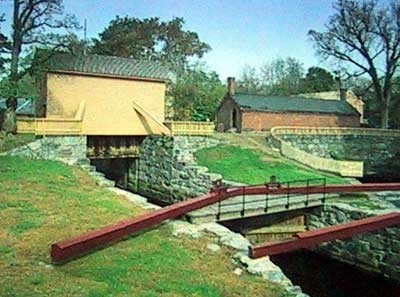
The Great Gate hung over Lowell’s Pawtucket Canal like a wooden wall waiting to fall. Completed in 1850, it was designed to block floodwater before it could rush down the canal toward the downtown mills. The National Park Service describes a 21-ton gate suspended above the lock chamber. [1]
The timber wall and its building are separate things. Massachusetts conservation planners describe southern-pine timbers held together by vertical iron rods, sheltered inside a tall, narrow clapboard gatehouse. Buttresses tie the building to its granite abutments. [2]
Where is this place?
Francis Gate, Guard Locks, Lowell, Massachusetts. This map locates the town or region, not a verified exact historic event site.
James B. Francis, chief engineer of the canal company, had identified a weakness at Guard Locks: its ordinary lock doors could not hold back an exceptional river flood. He had studied evidence of an earlier flood in 1785 rather than treating the more recent river levels as the limit. [3]
On 22 April 1852, after snowstorms and days of rain, a worker severed the iron shackle holding the gate. It dropped into the chamber and held back the water. [1] The park’s account does not establish who released it; gatekeeper Isaac Page is a suggested name, not a confirmed one. [3]
Four years later, 25 local citizens presented Francis with a silver pitcher and tray. The pitcher carried an engraved picture of the gate—a small version of the structure that had protected the downtown mills. [1]
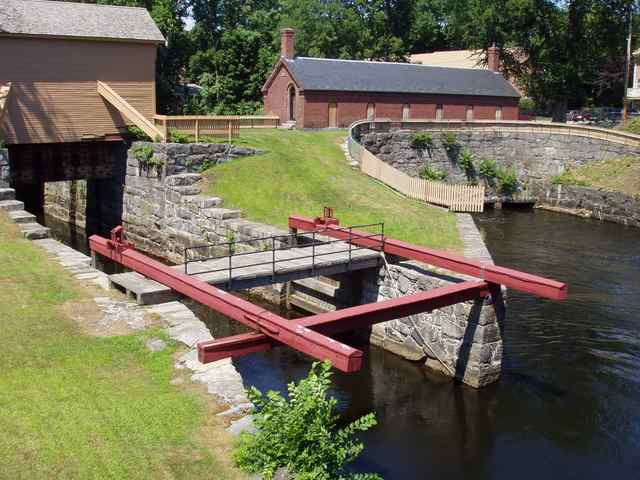
The wooden gate was used again in 1936. But the flood response in 2006 did not repeat that dramatic drop. According to the park’s history, the old gate remained up while steel beams formed a new stop-log barrier. The material had changed; water was still being kept out of the canal. [3]