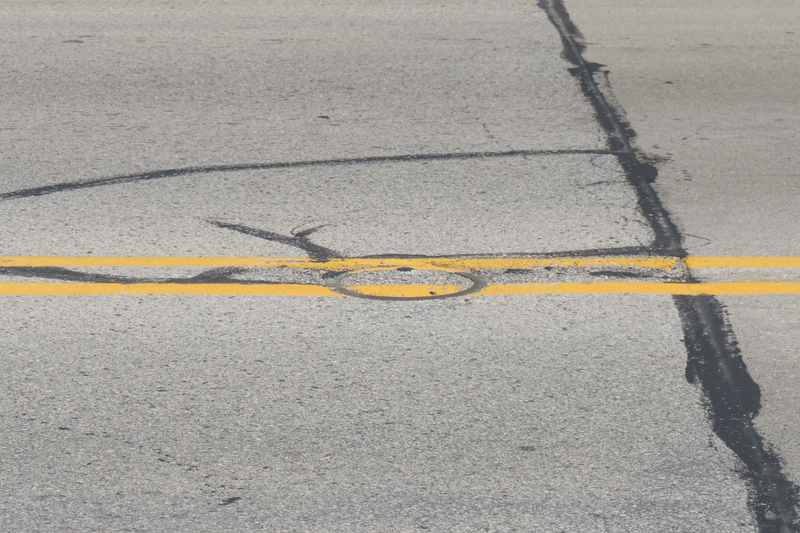
In Michael Barera’s June 2023 photograph of North Eighth Street in Manitowoc, Wisconsin, a metal ring interrupts the road’s double yellow line. There is no spacecraft inside it. The ring marks where a fragment fell, not where it remained.
That distinction is the town’s space story in miniature. The Soviet test spacecraft known in the West as Sputnik IV broke up on 5 September 1962. A piece reached Manitowoc; scientific investigation and diplomacy carried it elsewhere. Local people found other ways to keep the event attached to its address. [1][2]
Where is this place?
Rahr-West Art Museum, Manitowoc — museum beside the commemorated street, not a road-standing viewpoint. This map locates the town or region, not a verified exact historic event site.
First, it had to stop being ordinary junk
James C. Spry’s account in the April–June 1963 Civil Service Journal begins the local discovery with two patrolmen noticing an object in the street. On a later pass, they moved it out of the traffic. Only after hearing news reports did they return for it. [3]
Getting it recognised took more than picking it up. Local foundry and shipyard personnel could not identify it. A visiting salesman carried it to the Milwaukee Journal; the newspaper contacted Moonwatch observer Ed Halbach. Another observer, Gale Highsmith, flew it to the Smithsonian Astrophysical Observatory in Cambridge, Massachusetts. [3]
There, researchers photographed and measured the metal, cut a section from it and investigated evidence of exposure to space. The ordinary-looking object became a scientific specimen through a chain of people and tests—not simply because it had appeared beneath a reported fireball. [3]
Keeping the shape
Spry reported that Soviet Embassy representatives accepted the remaining fragment on 5 January 1963. He also acknowledged the disappointment of people who had hoped it would go to an American museum, including Manitowoc’s. That disappointment was already part of the story before the city installed its street memorial. [3]
Copies offered a different kind of possession. Manitowoc’s museum history records the Common Council accepting two replicas on 17 September 1963. Receiving two does not establish how many copies existed altogether. [1]
Gene Hanson’s history for the Milwaukee Astronomical Society adds a smaller, domestic scene. Drawing on recollections from Halbach’s daughters, he describes the fragment on their father’s kitchen table and reports that Halbach made four casts using a cement-pillar form. This is family testimony preserved in the society’s history, not a surviving production register. It does not, by itself, establish the provenance of the two replicas the city later accepted. [4]
Keeping the place
A copy could preserve the object’s shape. The street needed something else. NASA historian Colin Fries’s 2007 account dates the machinists’ installation of a brass ring to 15 November 1963. The city’s history identifies the local organisers as members of Lodge 516 of the International Association of Machinists. [1][2]
Even a permanent marker needs careful reading. The nearby plaque, visible in AltioraPeto’s 2008 photograph, gives 6 September 1962 as the recovery date. The city’s account and Fries’s history place the fall on 5 September. The inscription should not silently replace that chronology; the sources used here do not explain its choice of date. [1][2]
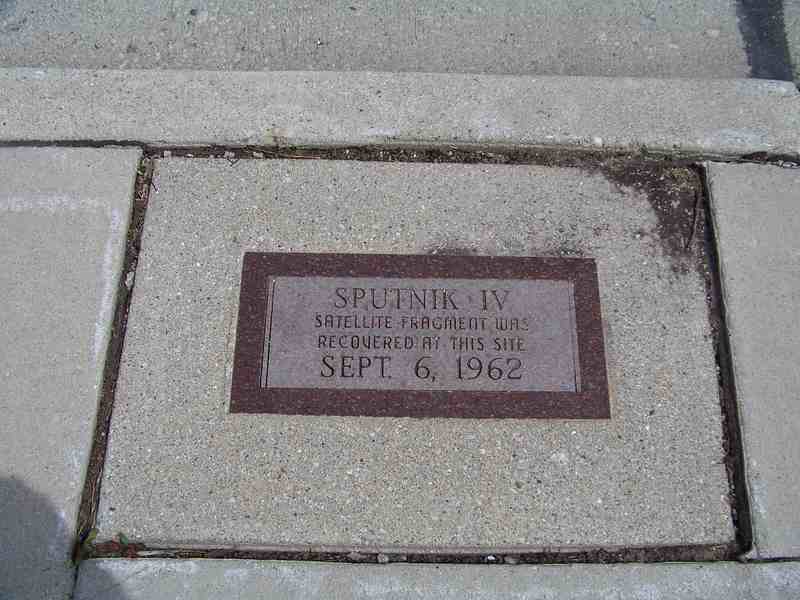
The ring, plaque and replicas preserve different things: a location, a written account and a shape. None requires the original fragment to remain in town. Manitowoc lost custody of a remarkable object, but it kept a way to point to an otherwise ordinary street and say: here.