The stripes would not appear across Betelgeuse’s image. On 13 December 1920 at Mount Wilson, the observing team searched for them with the interferometer’s outer mirrors 121 inches apart. Other stars had produced the pattern. The team then turned the instrument towards another star, and the fringes returned with hardly any adjustment. [1]
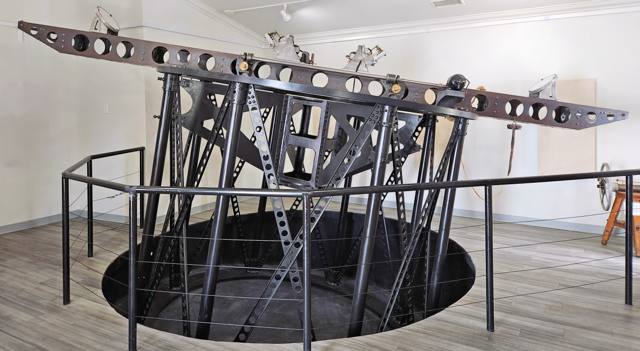
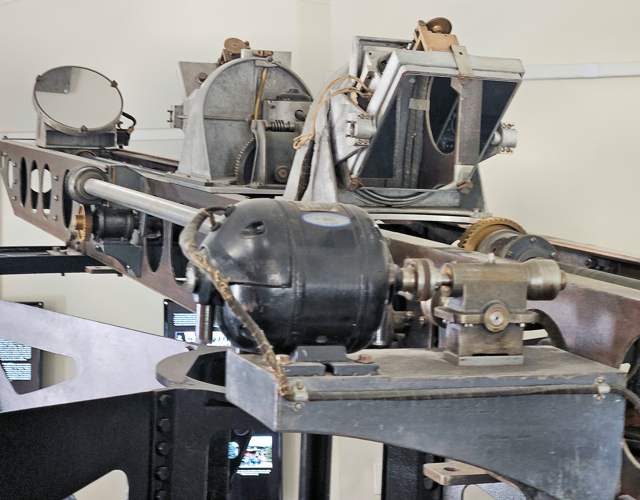
Albert Michelson and Francis Pease’s apparatus added mirrors on a twenty-foot beam to the observatory’s 100-inch telescope. Its mirrors combined light from separated paths to make interference stripes, or fringes. [1][2]
Where is this place?
Mount Wilson Observatory, California. This map locates the town or region, not a verified exact historic event site.
In their 1921 paper, Michelson and Pease explained why the check on other stars mattered: the missing Betelgeuse fringes could not simply be blamed on mirrors disturbed when the telescope changed position. The separation at which the pattern disappeared gave them the star’s angular diameter—its apparent width in the sky. They reported 0.047 seconds of arc, with about ten per cent uncertainty, assuming an evenly bright disk. The paper also credits J. A. Anderson with checking that night’s measurements. [1]
Poorer atmospheric conditions on following nights prevented the planned attempt to observe another maximum and minimum in Betelgeuse’s fringe pattern. [1]