The crabs beneath Central Park’s Egyptian obelisk are younger than the stone—and younger than the crab-shaped supports they replaced. New ones were cast when the monument arrived in New York in 1881. In 2014, those replacements received conservation attention of their own. An ancient monument had acquired historic modern parts. [1][2]
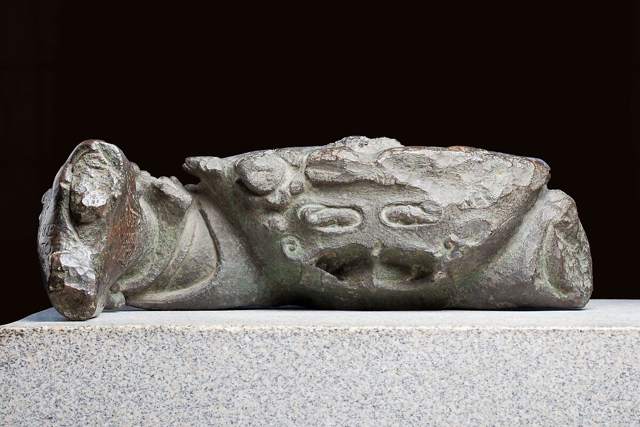
Two surviving Roman crabs belong to the Metropolitan Museum of Art, beside the park. The museum records describe them as supports for damaged corners when the obelisk was re-erected in Alexandria. Henry H. Gorringe, who organised its journey to New York, gave them to the museum in 1881. The photographs here show those originals, not the supports under the outdoor monument. [1]
Where is this place?
Central Park’s Obelisk, New York City — outdoor monument context; photographs show originals held by the neighbouring Met. This map locates the town or region, not a verified exact historic event site.
One claw carries more than an animal’s shape. The Met identifies inscriptions in Greek on the outside and Latin on the inside of object 81.2.2. They name the prefect Barbarus and architect Pontius in connection with the obelisk’s re-erection. A piece made to support stone also preserved a written record of moving it. [1]
The Conservancy’s 2014 annual report gives the later castings their own small place in a much larger treatment. Its caption explicitly dates the bronze replacements to 1881 and records their laser cleaning. For the stone above, planning had begun in 2011 with photography, scanning and a condition survey; cleaning began in May 2014, followed by stabilising fragile surfaces with adhesives. The account distinguishes documenting, cleaning and securing the monument rather than presenting them as one operation. [2]
Building Conservation Associates, which worked on the obelisk, describes scaling and exfoliation on the granite shaft and supporting block. Its treatment list includes consolidation, adhesive injection, grout repairs and removal of biological growth. That is not a claim that lasers repaired every problem, or that the same treatments were applied to the bronze crabs. The materials and their failures demanded different kinds of attention. [3]
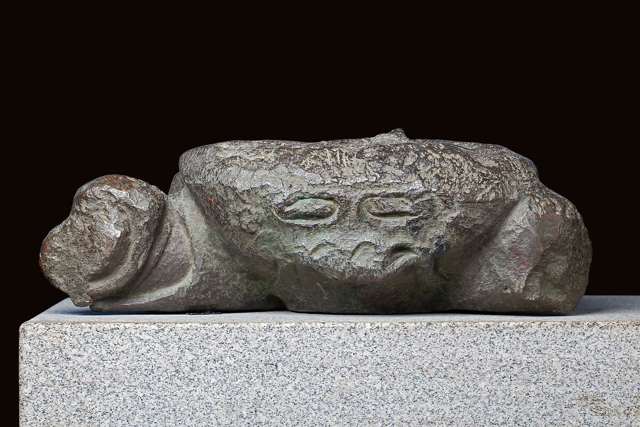
The contrast is not simply between an authentic object indoors and a false one outside. The museum crabs retain evidence of an earlier installation; the later castings belong to the obelisk’s New York life. Their conservation makes the distinction worth keeping, rather than smoothing away. Here, even the replacement parts have a history that is not interchangeable with the originals. [1][2]