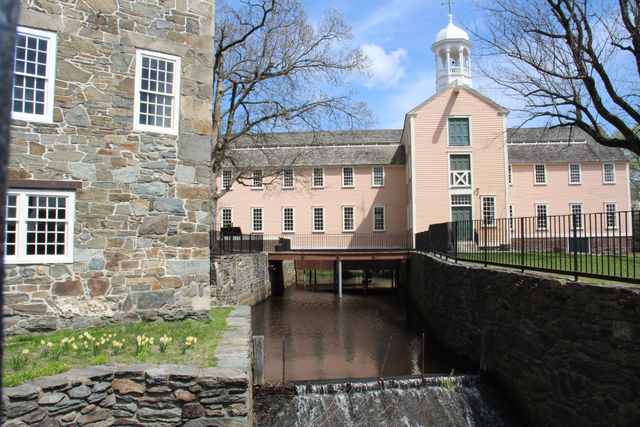
The water channel beside Old Slater Mill makes a persuasive picture of an early factory: stone walls, moving water and a wooden building with a bell tower. But the view does not tell us which generation of machinery lies beneath the floor. In Pawtucket, Rhode Island, restoring the mill’s earlier appearance did not mean rebuilding its earliest power system.
The distinction matters because this was never a building that simply stopped changing in 1793, the year it opened. The National Park Service’s history describes repeated enlargements during the nineteenth century. A surviving early core became part of a much longer working life. The familiar exterior is also the result of later decisions about which period visitors should see. [1]
Where is this place?
Old Slater Mill, 67 Roosevelt Avenue, Pawtucket, Rhode Island — public historic-site context, not an underground machinery location. This map locates the town or region, not a verified exact historic event site.
The wheel was not the priority
The 1924–25 restoration removed later additions and cleared neighboring workshops. In their 1991 Historic American Engineering Record study, Emma J. H. Dyson and Louis P. Hutchins traced the work through plans and correspondence. They found that salvaged bricks and timbers helped repair the retained mill. Returning to an earlier appearance required construction as well as subtraction. [2]
Power was treated differently. The historians cited a 1923 interview in which association president Henry Dexter doubted that restoring the wheel would attract much interest. Their investigation recorded two turbines still in the wheel pit: a Jonval beneath the stair tower and a Francis beneath the main building. They placed the probable change from waterwheels to turbines between May 1865 and April 1867. [2]
That survival is documented in the 1991 study, not asserted here as a new inspection of the machinery. Nor were the turbines the mechanism that powered the mill when it opened. The restoration had left different historical moments alongside—and underneath—one another.
A restored building was not yet the finished museum
The Old Slater Mill Association’s own timeline adds another separation. Founded in 1921, it raised money, restored the building and continued struggling to finance its care. During the Depression, the association sought help to block the Great Flume because of flood risks. Its museum and shop did not begin regular public operation until July 1955. [3]
The association also records changing paint colors: yellow after the 1920s restoration, then schoolhouse red in the 1940s to distinguish the mill among surrounding buildings. Even the presentation of the saved structure kept evolving. [3]
These are not reasons to dismiss the place as inauthentic. They are reasons to ask a more useful question than whether it is simply “original.” Original to which use, which room and which decade?
More than a machine story
The history also extends beyond what water could turn. The National Park Service and Stages of Freedom’s Laboring for Freedom exhibit connects the children spinning cotton at Slater Mill with the enslaved people who harvested that cotton. An account of ingenious machinery alone would leave those workers outside the frame. [4]
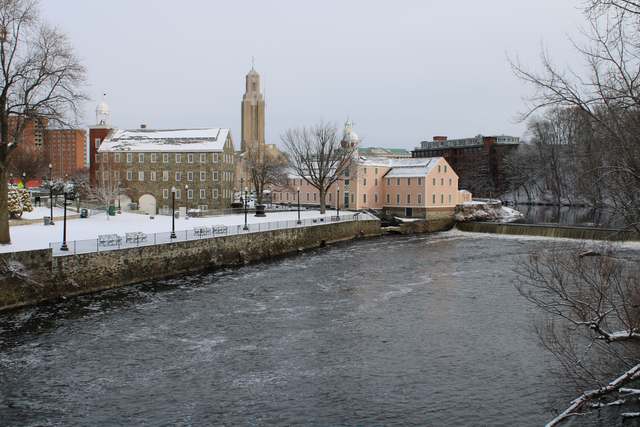
The two photographs here offer different scales: the Great Flume close to the building, and the mills beside the river in winter. Neither shows the turbines or proves how a historic power arrangement worked. They locate the question. Beneath an exterior selected to evoke an earlier age, the restoration record preserves evidence of a factory that had already moved on.