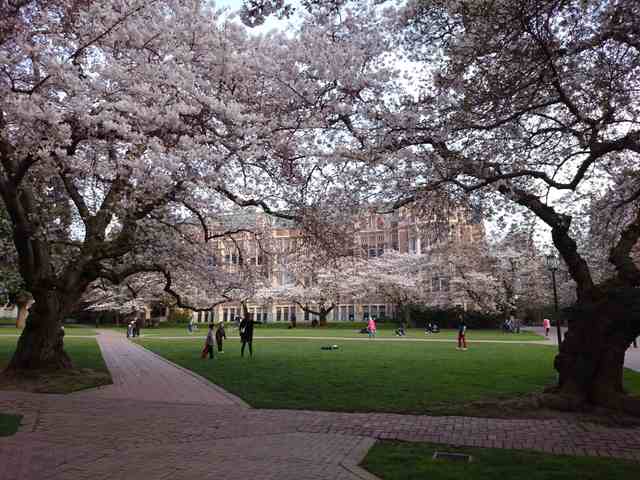
The leaves came from low branches on three cherry trees near Raitt Hall. In the summer of 2025, four University of Washington students used those samples to investigate a question the Quad’s much-photographed blossoms could not settle: where had these trees come from? [1, 2]
Aiden Eno, Nandini Pathak, Caitlin Dong and Preston Lam worked with graduate student Ben Sheppard and biology professor Adam Steinbrenner. The Harkess Lab at the HudsonAlpha Institute for Biotechnology in Alabama supplied the sequencing. Back at UW, the project turned that information into comparisons with trees in Japan. [1, 2]
Where is this place?
Liberal Arts Quadrangle, University of Washington, Seattle. This map locates the town or region, not a verified exact historic event site.
The university’s Campus Sustainability Fund awarded $16,500 to the project. Its 2024 proposal planned to sequence four Quad trees; the team’s published methods describe samples from three. The reported comparison then follows one of them, labelled UWQ1, alongside 46 Japanese trees from an earlier study. These are different stages of the work, not a census of every cherry in the Quad. [2, 3]
The team compared variations at 684 positions in the DNA. Its results place UWQ1 close to sampled trees in Okayama, Matsue and Tokyo. Two of the close matches were on the Shimane University campus in Matsue; another was in Tokyo’s Ueno Park. The researchers suggest that the older Ueno tree might be a progenitor of this group, but say a fuller historical comparison is needed. [2]
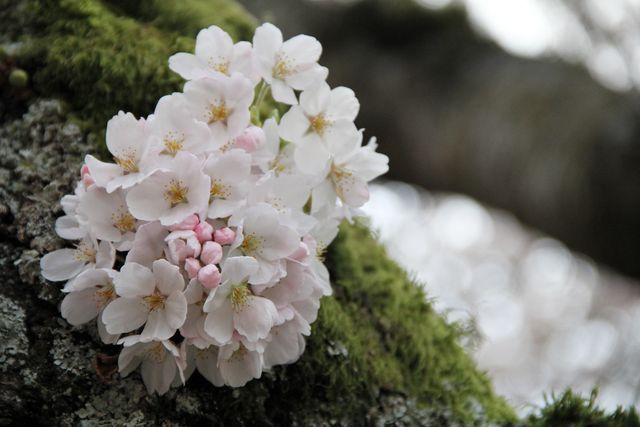
That history already contains a correction. UW’s March 2026 account credits visiting Waseda University student Yuki Shiotani with establishing that the trees moved from Washington Park Arboretum to the Quad in 1962. Their arrival at the Arboretum remains unsettled. A familiar account of a 1939 purchase lacked direct evidence. [1]
The genetic comparison has therefore supplied a set of relatives to investigate, rather than a documented journey from a particular Japanese park to Seattle. In the team’s proposed history, a connection through Okayama is still a possibility to test against the records. [2]