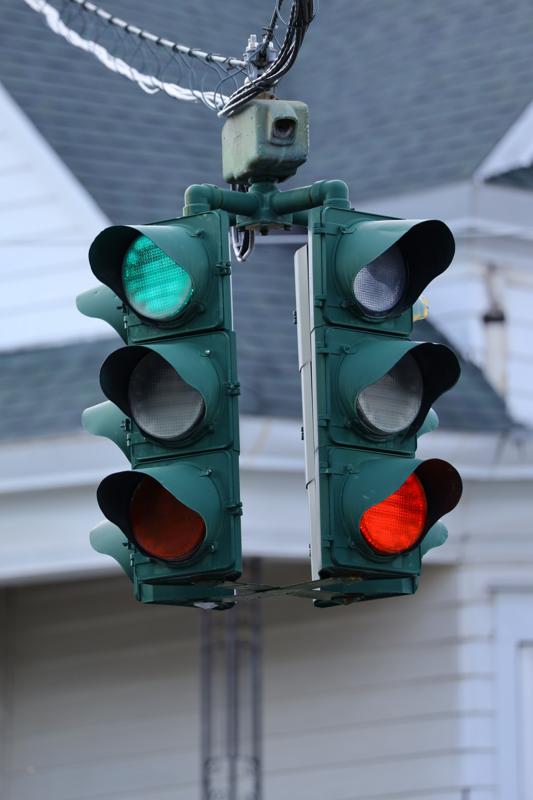
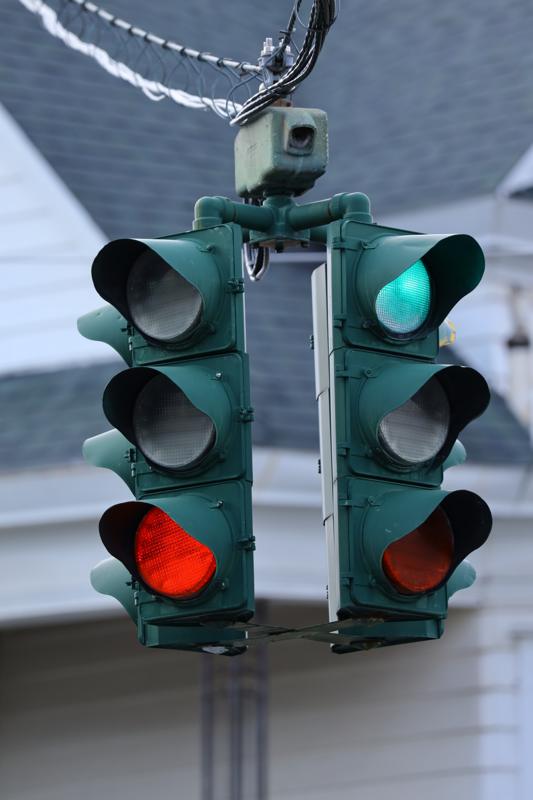
The two photographs were taken eleven seconds apart. In one, a green lamp glows at the top of one face of the hanging traffic signal; in the other, the adjacent face has its green lamp illuminated. The red lamps are below. At Syracuse’s Tipperary Hill, an ordinary change of lights reveals an extraordinary arrangement.
Three years after formulanone made those photographs, another object joined the neighbourhood’s telling of the story. On 17 March 2026, residents gathered for the unveiling of a roadside marker commemorating the green-on-top light. The marker was green, too. [1]
Where is this place?
Tipperary Hill, Syracuse — neighbourhood context, not traffic or parking guidance. This map locates the town or region, not a verified exact historic event site.
That colour was a deliberate departure. The William G. Pomeroy Foundation’s dedication fact sheet explains that its Legends & Lore markers are normally deep red with beige lettering. It described this one, at the time of the dedication, as the only marker in that programme produced in green. The sign did not merely explain the light. Its design echoed the reason people remembered it. [2]
A story can become part of a junction
The foundation’s marker record places the light at Tompkins Street and Milton Avenue. Its account retells a neighbourhood legend from the 1920s: young Irish-American residents objected to a red lamp above a green one, reading the arrangement as British red over Irish green. Repeated stone-throwing, the story goes, eventually persuaded the city to reverse the order. [3]
That is the tradition being commemorated, not a newly established finding from municipal repair records. The published accounts do not even settle on a single early date. The marker inscription and its accompanying foundation narrative give different years. An exact anniversary would promise more certainty than these sources provide. [3]
The distinction matters because the sign belongs to Legends & Lore, not simply to an undifferentiated collection of historical plaques. The programme describes legends as inherited stories regarded as historical but not verifiable. It requires supporting documentation that a story qualifies as folklore; it does not require primary evidence for every narrated event. That is a defined purpose, not an absence of scrutiny. [4]
The people beside the plaque
The Tipperary Hill Neighborhood Association received the marker grant, and New York Folklore reviewed the application. Preserving the story involved an organisation, a grant and an outside folklore partner—not only a familiar object overhead. [2]
Local reporting from the dedication shows why that effort mattered to some families. In John Smith’s WAER account, Kathy Short Grajko recalled her father Francis “Stubbs” Short explaining how the boys avoided being caught. This is her reported recollection of his account, not testimony collected for this article. [5]
Jimmy Conroy, identified by WAER as Patrick “Packy” Corbett’s grandson, connected the occasion with family, friendship and the experience of migration. In Jacob Erlbaum’s separate NCC News report, Conroy stressed the value of giving later generations a way to understand why the place mattered. The two reports preserve voices from the event; they are not independent proof of every incident in the older legend. [1][5]
The photographs here predate the marker. They show the working signal’s unusual arrangement, not the 2026 ceremony or a reconstruction of the stone-throwing. That leaves two different kinds of evidence in view: an observable object and a community’s account of how it acquired meaning.
At Tipp Hill, green is both a lamp’s position and a story worth handing on. In 2026, even the sign telling that story declined to be red.